





LLM for Business: How to Implement Language Models in Your Company [2026]
How to implement an LLM in your company: use cases, model comparison, RAG, and implementation steps. Practical 2026 guide.
 Víctor Mollá7 min read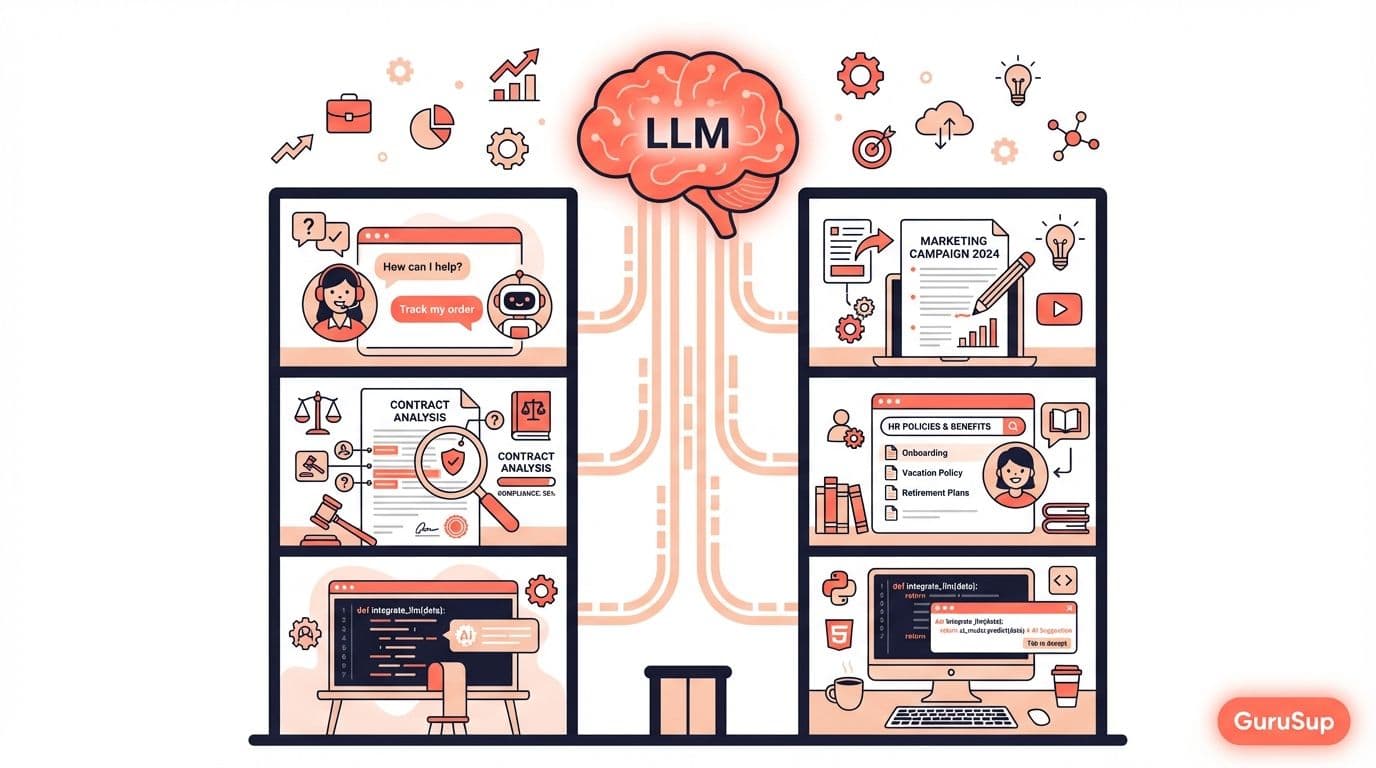
Why companies need LLMs
LLMs (Large Language Models) have stopped being a laboratory experiment to become business infrastructure. According to McKinsey, 65% of organizations already experiment with generative AI regularly--double from barely ten months earlier. We're not looking at a tech fad; we're looking at a structural shift in how companies process information, communicate with customers, and make decisions.
Use cases are concrete. Automate customer service with agents that understand natural language. Generate personalized marketing content at scale. Analyze contracts, financial reports, and legal documentation in seconds instead of hours. Create internal assistants that centralize company knowledge--HR, IT, legal--and make it accessible to any employee without searching twenty different systems.
The fundamental value proposition is this: an LLM acts as an intelligence layer over your own data. It's not about the model "knowing everything". It's about it being capable of reasoning over your company-specific information--your products, your policies, your customer history--and generating useful answers in real time. That's the difference between using ChatGPT as a toy and deploying a language model as a business tool. For a complete technical view of the ecosystem, check our LLM and language models guide.
5 business use cases
1. customer service
The most immediate case with the highest return. An LLM powers chatbots and AI agents that understand context, maintain natural conversations, and resolve queries without following rigid decision trees. The difference from a classic chatbot is abysmal: the agent understands language variations, spelling errors, and ambiguous requests. Mature implementations report autonomous resolution rates of 60% to 80%. Dive deeper in our business chatbot guide.
2. document analysis
200-page contracts, quarterly reports, emails accumulated over months. An LLM extracts relevant clauses, summarizes key points, and answers specific questions about content. Legal, compliance, and finance departments are the first beneficiaries. What previously required hours of reading is resolved in seconds--with the ability to cross-reference information across multiple documents simultaneously.
3. content generation
Marketing, sales, and product generate growing content volumes: personalized emails, product descriptions, social media posts, technical documentation. An LLM doesn't replace the creative team but eliminates repetitive work. First draft generated in seconds, tone adaptation per channel, personalization at scale--what previously required a dedicated copywriter for each variant.
4. internal knowledge assistant
Every company has knowledge scattered across wikis, shared documents, Slack, emails, and veteran employees' heads. An LLM-based assistant centralizes that knowledge and makes it queryable in natural language. New hires getting up to speed in days instead of weeks. Employees finding HR, IT, or legal answers without opening a ticket. Productivity impact is measurable from the first month.
5. process automation
Automatic support ticket classification, intelligent routing by urgency and topic, structured data extraction from unstructured forms. An LLM understands the intention behind text and makes routing decisions that previously required human intervention. This directly connects with customer support automation at scale.
How to choose an LLM for your company
Not all language models are equal. The choice depends on your use case, privacy requirements, and budget. This table summarizes the main 2026 options.
| Criterion | OpenAI GPT-5.4 | Claude (Anthropic) | Gemini (Google) | Llama (Meta) |
|---|---|---|---|---|
| Best for | General, multimodal | Long documents, analysis | Google Workspace | Self-hosted, customization |
| Privacy | Cloud | Cloud (SOC2) | Cloud | On-premise possible |
| Cost | $$$/token | $$/token | $$/token | Own infrastructure |
| Spanish language | Good | Very good | Good | Variable |
The decision isn't just technical. If your data is confidential and regulation prevents you from sending it to a third party, Llama allows on-premise deployment with total control. If you need to process long documents--contracts, regulatory reports--Claude from Anthropic offers superior context windows. If you already live in the Google Workspace ecosystem, Gemini integrates natively. And GPT-5.4 from OpenAI remains the most versatile option for general and multimodal use cases.
Practical recommendation: start with a cloud API to validate the use case. Migrate to self-hosted solutions only when volume or privacy requirements justify it. Also check our best LLM for chatbot comparison.
RAG: the key to enterprise LLMs
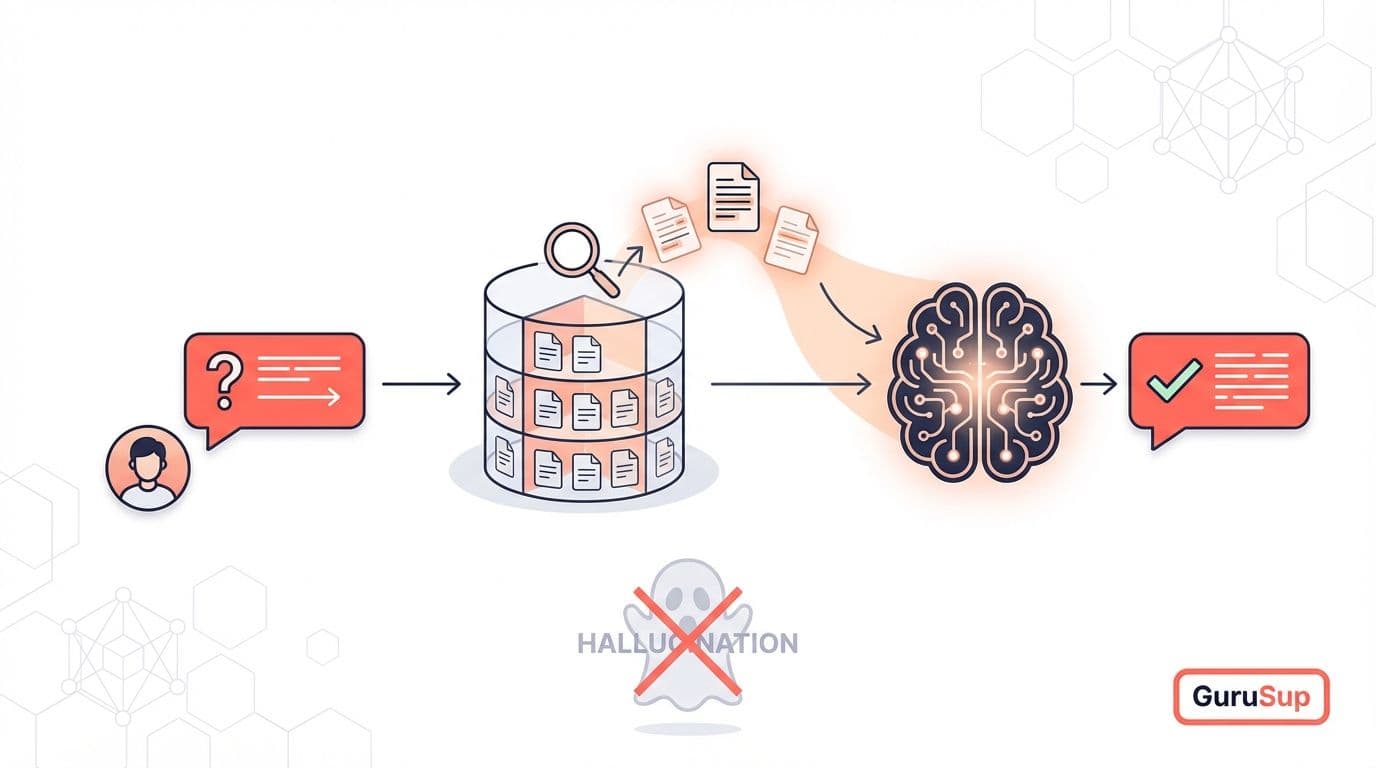
The biggest problem with LLMs in business environments is hallucinations: the model generates answers that sound correct but are invented. The solution is called RAG (Retrieval-Augmented Generation).
The concept is straightforward. Instead of relying solely on the model's knowledge, the system first searches for relevant information in your own database--documents, FAQs, manuals, CRM--and provides it to the LLM as context before generating the response. The model doesn't "remember" your data; it consults it in real time. This drastically reduces hallucinations and guarantees that answers are anchored in verified and updated information.
Without RAG, an enterprise LLM is a risk. With RAG, it's a reliable tool. For a complete technical analysis of this architecture, check our dedicated RAG and LLM guide.
Steps to implement an LLM in your company
Implementation doesn't start with choosing a model. It starts with identifying the problem.
- Identify the specific use case. Not "we want AI". But "we want to reduce level 1 support tickets by 50%" or "we want the legal team to review contracts in minutes, not days". A specific use case with a measurable success metric.
- Prepare the data. The LLM is only as good as the information you give it. Updated documentation, clean knowledge base, structured data. If your internal wiki has 2019 articles that no longer apply, the model will use them anyway. Garbage in, garbage out.
- Choose model and architecture. Cloud API to start quickly with low initial cost. Self-hosted if data is sensitive and volume justifies infrastructure investment. The previous section's table is your starting point.
- Implement RAG. Connect the LLM to your own data sources. Vector database, indexing pipeline, retrieval layer. This is the piece that converts a generic model into an assistant that knows your company.
- Testing and evaluation. Before putting the system in production, test with real cases. Measure answer accuracy, residual hallucinations, and user satisfaction. Fine-tuning can improve results for very specific domains, but RAG covers 80% of cases.
- Continuous monitoring and optimization. An LLM isn't a "deploy and forget" project. Monitor metrics, update the knowledge base, adjust prompts, and periodically evaluate if the chosen model is still the most appropriate. The ecosystem evolves every quarter.
Frequently asked questions
How much does it cost to implement an LLM in a company?
Depends on architecture. A cloud API-based solution (like OpenAI or Anthropic) can start from 500-2,000 EUR/month for moderate volumes. A self-hosted implementation with Llama requires GPU investment--from 5,000 EUR/month in cloud to tens of thousands in own hardware. ROI is measured against the cost of the process you're automating: if a 5-person team dedicates 60% of their time to tasks the LLM resolves, the numbers work out quickly.
Is it safe to use LLMs with confidential data?
With proper precautions, yes. Enterprise APIs from OpenAI and Anthropic offer SOC2 certification and guarantees of not training with your data. For maximum security, on-premise deployment with open-source models like Llama eliminates sending data to third parties. The key is defining what data the model can see and what it can't.
Do I need a Machine Learning team to use LLMs?
Not to start. Current APIs allow integrating an LLM with basic development knowledge. A Machine Learning team becomes necessary when you want model Fine-tuning, complex RAG architectures, or self-hosted deployment at scale. For most companies, a senior developer and a good platform provider are enough for the first use case.
GuruSup uses LLM and RAG to deploy AI agents that automate customer support on WhatsApp--with access to your knowledge base, CRM integration, and transparent escalation to the human team. Read our guides on how GuruSup uses LLMs to automate customer support. Try GuruSup free.