






RAG: What is Retrieval-Augmented Generation and How It Improves LLMs
What RAG (Retrieval-Augmented Generation) is, how its technical pipeline works, differences with fine-tuning and tools to implement it with LLMs in 2026.
 Víctor Mollá7 min read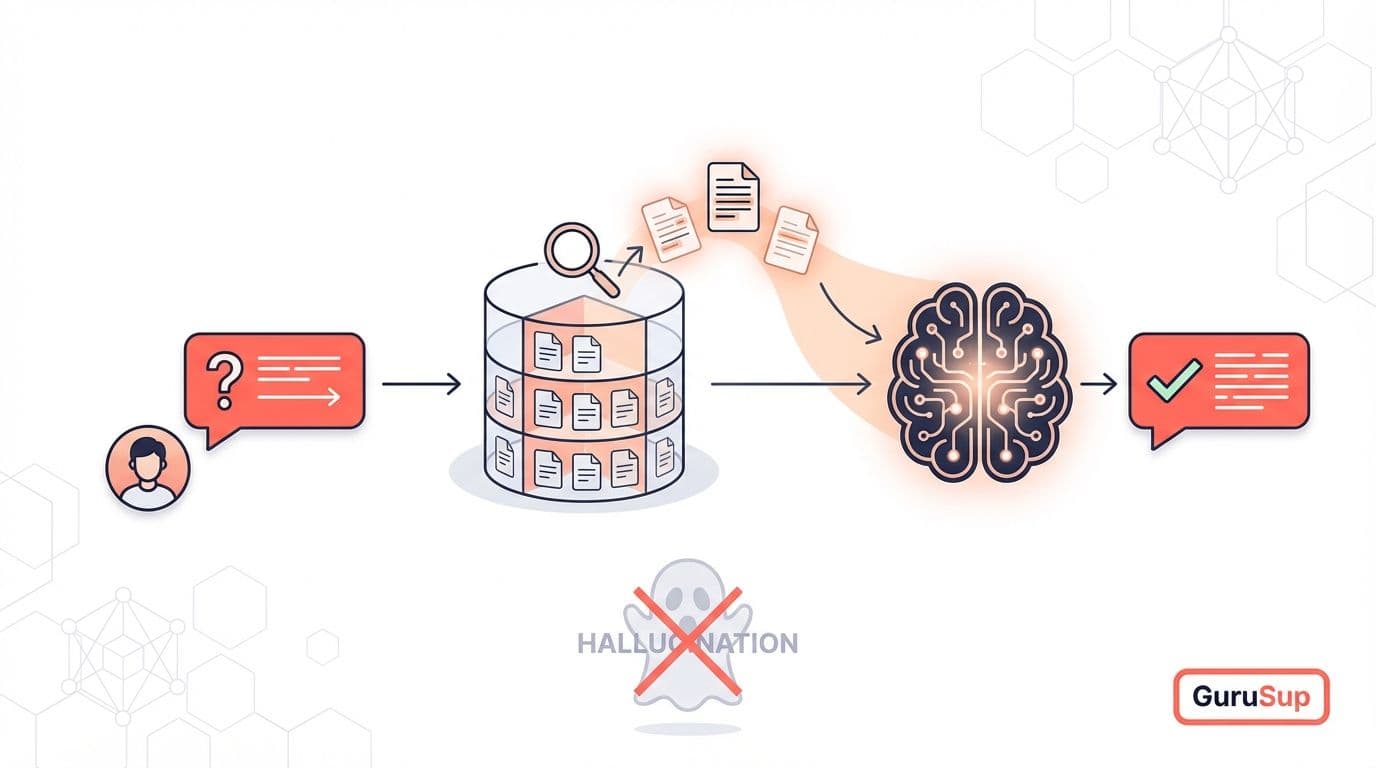
What is RAG
RAG (Retrieval-Augmented Generation) is an AI architecture that combines information retrieval from external databases with the generative capacity of LLMs, enabling accurate responses based on updated and proprietary data.
The concept was introduced by Facebook AI Research in 2020, through Lewis et al.'s paper titled Retrieval-Augmented Generation for Knowledge-Intensive NLP Tasks. The central idea was simple but powerful: instead of forcing the model to memorize all world knowledge during training, give it the ability to query external sources in real-time before generating each response.
The problem RAG solves is twofold. First, hallucinations: LLMs like GPT-5.4, Claude, or Gemini are excellent at generating coherent text, but when they don't have concrete information, they invent it with disturbing confidence. Second, obsolescence: a model trained with data up to a certain date can't know what happened afterward. If your team needs an assistant to answer about this week's rates or the return policy updated yesterday, an LLM without RAG has no way to do it.
RAG in artificial intelligence has become the standard architecture for any enterprise application that needs reliable and traceable responses. It's not a new model or specific framework: it's an architectural pattern you can implement with different tools and on any LLM. To understand the models that act as the generative engine in this pipeline, check out the guide on LLM: language models.
How RAG works
The RAG pipeline is divided into four well-differentiated phases. Understanding each is fundamental to implement a system that actually works and isn't just a demo prototype.
1. indexing
Everything starts with your company's documents: manuals, FAQs, product sheets, internal policies, any relevant knowledge source. These documents are divided into fragments (chunks) of a manageable size, normally between 256 and 1024 tokens. Each chunk is transformed into a numeric vector through an embeddings model (like OpenAI ada-002 or Cohere embed-v3). These vectors are stored in a Vector Database, which is the search brain of the entire system.
2. retrieval
When a user launches a question, it's equally converted into an embedding. The system performs a semantic search in the Vector Database, comparing mathematical proximity between the query vector and stored vectors. The result is the top-K most relevant documents: not those that literally match the question's words, but those that are semantically close to the user's intention.
3. augmentation
This is where the magic happens. The system builds a prompt composed of three elements: the user's original question, the context fragments retrieved in the previous phase, and system instructions (system prompt) that define the model's behavior. This enriched prompt gives the LLM all the information it needs to respond with foundation, not imagination.
4. generation
The LLM receives the augmented prompt and generates a response based on the actual context provided. The difference with generation without RAG is radical: now the model can cite sources, reference concrete data, and respond with information it never saw during training. If it doesn't find enough information in the retrieved context, a well-configured system will respond that it doesn't have sufficient data instead of inventing.
The key stack components are: Vector Database (Pinecone, Weaviate, Chroma), embeddings model (OpenAI ada, Cohere), and orchestrator (LangChain, LlamaIndex). Each piece is interchangeable, allowing you to adjust the stack to your cost, latency, and volume needs.
RAG vs fine-tuning
One of the most frequent questions is whether it's better to use RAG or do model fine-tuning. The short answer: it depends on the problem, but RAG wins in most business cases.
| Aspect | RAG | Fine-tuning |
|---|---|---|
| Data | External, updatable in real-time | Incorporated within the model |
| Cost | Low-medium (vector infra + API) | High (GPU, labeled data, time) |
| Update | Immediate (update documents) | Requires model retraining |
| Hallucinations | Reduced (cites concrete sources) | Persist if data doesn't cover the case |
| Traceability | High (you know where each data comes from) | Low (knowledge dilutes in weights) |
| Best for | FAQ, support, docs, knowledge bases | Writing style, very specific domain |
Fine-tuning makes sense when you need the model to adopt a very specific tone, vocabulary, or behavior that can't be achieved with prompting alone. Think of a model trained to generate medical reports with precise terminology or to write code in a proprietary language.
For everything else, RAG is the most practical option: you don't need dedicated GPUs, you can update information in minutes, and you maintain traceability of each response. In fact, the best systems combine both: a model with light fine-tuning for tone, fed with RAG for updated knowledge. If you're evaluating which LLM is best for chatbot, keep in mind that RAG architecture works with any of them.
RAG use cases in businesses
The application of RAG in enterprise environments has exploded in the last two years. These are the most common cases:
Support chatbots with knowledge base. This is the star use case. An AI chatbot powered by RAG can answer questions about products, policies, and procedures by consulting the company's actual documentation. GuruSup uses precisely this architecture so its AI agents respond with accurate and verifiable information from each customer.
Legal assistants. Law firms use RAG to search jurisprudence, legislation, and internal contracts, generating summaries and responses based on real documents.
Internal documentation search. Companies with thousands of internal documents implement RAG so their employees find answers without having to read hundreds of pages. It's the intelligent search every intranet needs.
Q&A on databases. Systems that combine RAG with SQL allow asking questions in natural language about structured data: "how many sales were there in January" automatically translates into a database query. To understand how this integrates at enterprise level, check out LLM for business.
Tools to implement RAG
The ecosystem of tools to build a RAG pipeline has matured considerably. Here are the main ones:
| Tool | Type | Ideal for |
|---|---|---|
| LangChain | Orchestration framework | Complex pipelines with multiple sources |
| LlamaIndex | Indexing framework | RAG focused on documents and search |
| Haystack | Open-source framework | Teams preferring self-hosted solution |
| Vectara | Managed RAG platform | Companies not wanting to manage infra |
| Pinecone + OpenAI | Combined stack | Rapid prototyping with scalability |
| Chroma | Local Vector DB | Local development and proof of concept |
| Weaviate | Hybrid Vector DB | Semantic search + structured filters |
The choice depends on the level of control you need, your budget, and whether you prefer to manage it yourselves or delegate to a service. For most starting companies, LangChain + Pinecone + an OpenAI model is the most documented stack with the least initial friction.
Frequently asked questions about RAG
What does RAG mean in artificial intelligence?
RAG stands for Retrieval-Augmented Generation. It's an architecture that allows language models to query external information sources before generating a response, combining search and generation in a single pipeline.
Does RAG eliminate LLM hallucinations?
It drastically reduces them, but doesn't eliminate them completely. A well-configured RAG system bases its responses on real documents and can refuse to respond if it doesn't find enough information. However, if indexed documents contain errors or the model misinterprets context, inaccuracies can occur. The key is in document quality and prompt design.
Can RAG be used with open-source models?
Absolutely. RAG works with any LLM: GPT-5.4, Claude, Llama, Mistral, or any model that accepts a prompt with context. In fact, combining RAG with open-source models is a common strategy to reduce costs while maintaining data privacy, since the model can run on your own servers.
GuruSup uses RAG so your business AI agents respond with accurate, updated, and verifiable information. No invented responses: real data from your company in every conversation. Try it free.

![LLM: What Are Language Models and How Do They Work [2026 Guide]](/_next/image?url=https%3A%2F%2Fres.cloudinary.com%2Fdhqzl4gpk%2Fimage%2Fupload%2Fv1771362303%2Ffeatured_llm_modelos_lenguaje_7565f3ad49.jpg&w=3840&q=75)