





LLM: What Are Language Models and How Do They Work [2026 Guide]
What is an LLM (Large Language Model): how large language models work, main LLMs in 2026, business uses, risks and limitations.
 Víctor Mollá7 min read
![LLM: What Are Language Models and How Do They Work [2026 Guide]](/_next/image?url=https%3A%2F%2Fres.cloudinary.com%2Fdhqzl4gpk%2Fimage%2Fupload%2Fv1771362303%2Ffeatured_llm_modelos_lenguaje_7565f3ad49.jpg&w=3840&q=75)
An LLM (Large Language Model) is an artificial intelligence system trained with billions of parameters on enormous amounts of text to understand, generate, and reason with natural language. These models are the technological foundation of tools like ChatGPT, Claude, or Gemini.
Language models have stopped being a laboratory concept to become business infrastructure. McKinsey estimates that 65% of companies already use generative AI regularly, double from barely a year ago, driven by LLM adoption in customer service, marketing, and software development.
In this guide we cover what an LLM in AI is, how it works, the main models in 2026, their business applications, and their limitations. Each section links to specialized guides where we dive deeper into detail.
How an LLM works
To understand what a large language model is, we need to talk about the architecture that made it possible: the Transformer. Published in 2017 by Google researchers in the paper "Attention Is All You Need", the Transformer introduced the attention mechanism, which allows the model to weigh the relevance of each word in relation to all others in the text, regardless of the distance between them.
The process begins with tokenization: input text is divided into fragments called tokens (words, subwords, or characters). Each token is converted into a numeric vector through embeddings, mathematical representations that capture semantic meaning. These vectors pass through multiple Transformer layers, where the attention mechanism calculates contextual relationships between all tokens simultaneously.
LLM training develops in three phases. First, pretraining: the model reads billions of texts from the internet, books, and documents, learning statistical language patterns (grammar, facts, reasoning). Second, fine-tuning: it's trained with specific data for concrete tasks, like following instructions or answering questions. Third, RLHF (Reinforcement Learning from Human Feedback): human evaluators rate the model's responses, and that feedback adjusts its behavior to align answers with human expectations of usefulness and safety.
In simple terms: an LLM doesn't "understand" language like we humans do. It predicts the most probable next word given a previous sequence, but it does so with such statistical sophistication that the result is indistinguishable from genuine understanding for most practical applications.
Main LLMs in 2026
The language model ecosystem has matured considerably. These are the most relevant LLMs in 2026:
| Model | Company | Parameters | Notable for |
|---|---|---|---|
| GPT-5.4 | OpenAI | ~1.8T est. | Multimodal, most popular |
| Claude 4 | Anthropic | Not public | Advanced reasoning, safety |
| Gemini 3.1 | Not public | Native multimodal | |
| Llama 4 | Meta | 405B | Open-source |
| Mistral Large | Mistral AI | 123B | European, efficient |
The clear trend is convergence toward multimodal models that process text, image, audio, and video simultaneously. At the same time, models like Llama and Mistral democratize access with open licenses, allowing companies to deploy LLMs on their own infrastructure without depending on external APIs.
There's no universal "best LLM". The choice depends on use case, privacy requirements, and budget.
LLMs in business context
The application of language models in business goes far beyond generating text. LLMs are the engine that powers modern chatbots, AI agents, and knowledge automation systems. This is where theory becomes competitive advantage.
Implementing an LLM in a business environment requires strategy: choosing the right model, defining data flows, establishing security guardrails, and measuring real impact on business metrics.
👉 LLM for Business: Implementation Guide , How to integrate LLMs in business processes, from model selection to ROI measurement.
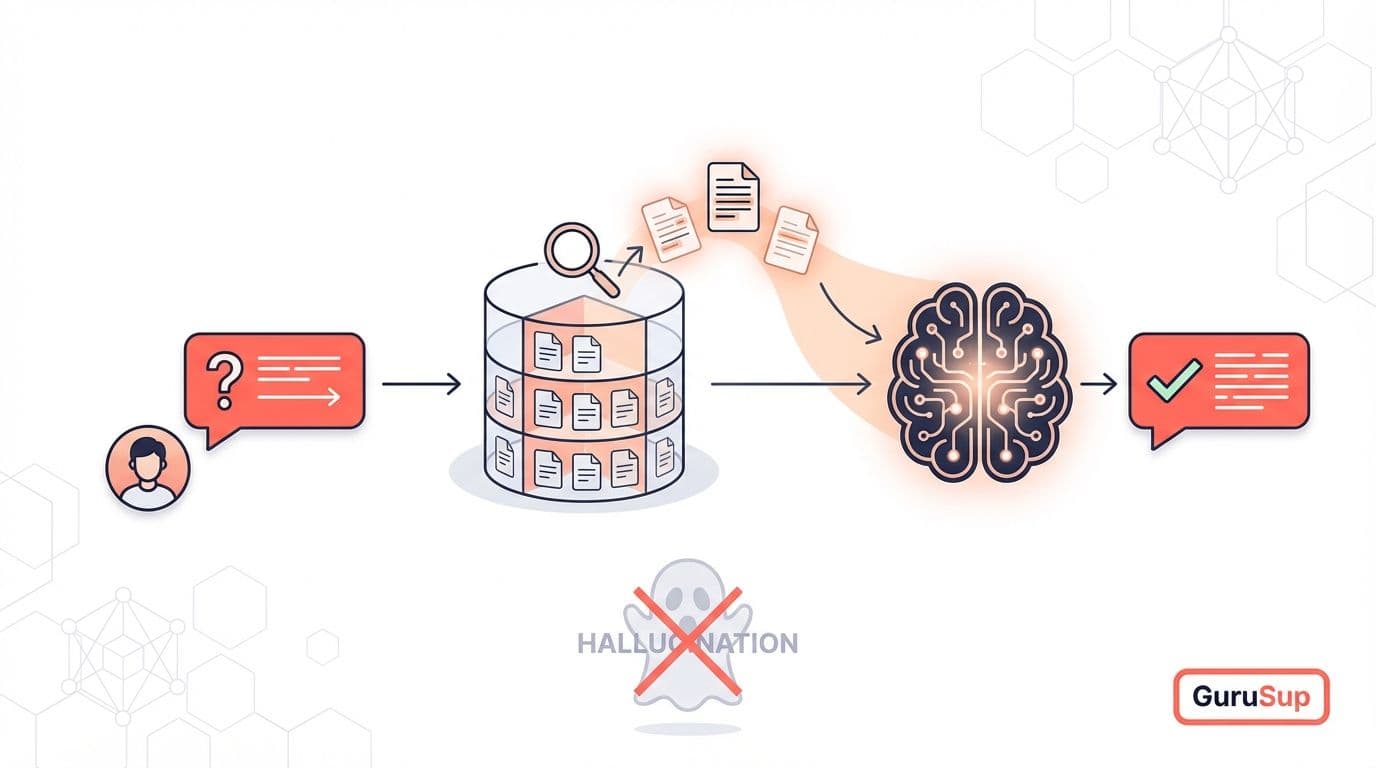
One of the most effective techniques to improve LLM accuracy in business contexts is RAG (Retrieval-Augmented Generation), which connects the model with your internal knowledge base so answers are based on verified data, not the model's parametric memory.
👉 RAG: What It Is and How It Improves LLMs — Retrieval-Augmented Generation explained: how to reduce hallucinations and contextualize responses.
The use case with the most immediate impact is automated customer service. Choosing the right LLM for a support chatbot involves evaluating latency, cost per token, quality in your language, and ability to follow complex instructions.
👉 Best LLM for Customer Service Chatbots — Model comparison for support: GPT-5.4 vs Claude vs Gemini vs open-source alternatives.
LLM vs traditional NLP
It's common to confuse LLM with NLP (Natural Language Processing), but they're not the same. Traditional NLP is a broad field that spans from sentiment analysis to automatic translation, using classic machine learning techniques: statistical models, linguistic rules, word2vec, LSTM. Each task required a specific model trained for that concrete purpose.
LLMs represent the evolution of NLP. A single large language model can perform translation, summarization, classification, text generation, entity extraction, and reasoning, all without additional training for each task (zero-shot learning). The fundamental difference is scale: while a classic NLP model trains with thousands or millions of labeled examples, an LLM learns language patterns from trillions of unlabeled tokens. The LLM doesn't replace NLP; it's its natural evolution at massive scale.
Risks and limitations
LLMs aren't infallible, and understanding their limitations is as important as knowing their capabilities. Hallucinations are the most known risk: the model generates information that sounds convincing but is incorrect. Techniques like RAG and grounding reduce this problem, but don't eliminate it completely.
Bias inherited from training data can produce discriminatory or culturally inappropriate responses. The computational cost of running models with trillions of parameters remains high, both economically and environmentally. Data privacy generates legitimate concern: sending customer data to external APIs involves regulatory compliance risks.
In Europe, the AI Act (European Artificial Intelligence Regulation) establishes obligations of transparency, human oversight, and risk assessment for AI systems that interact with consumers. Vendor lock-in is another factor: building your entire infrastructure on a single LLM exposes you to changes in price, policy, or availability.
Understanding these risks doesn't mean avoiding LLMs, but implementing them wisely. The customer success metrics and AI tool comparisons will help you make informed decisions. Similarly, understanding the complete customer journey allows identifying where an LLM adds real value and where human contact remains irreplaceable.
Frequently asked questions
What is an LLM in artificial intelligence?
An LLM (Large Language Model) is an artificial intelligence model based on the Transformer architecture, trained with billions of parameters on massive amounts of text. Its function is to understand and generate natural language. It's the technology that makes tools like ChatGPT, Claude, or Gemini capable of maintaining coherent conversations, summarizing documents, translating languages, and reasoning about complex problems.
What's the difference between GPT and LLM?
LLM is the general category: any large language model is an LLM. GPT (Generative Pre-trained Transformer) is a specific family of LLMs developed by OpenAI. That is, all GPTs are LLMs, but not all LLMs are GPT. Claude from Anthropic, Gemini from Google, and Llama from Meta are LLMs that don't belong to the GPT family.
What does LLM mean in ChatGPT?
ChatGPT is a chat application developed by OpenAI that uses an LLM (specifically, models from the GPT-5.4 family) as a language generation engine. The LLM is the brain; ChatGPT is the interface that allows users to interact with that brain through natural language conversations. Without the underlying LLM, ChatGPT couldn't generate responses.
Want to stay up to date on AI applied to customer success? Subscribe to our newsletter to receive practical guides on LLMs, AI agents, and intelligent automation directly in your inbox. Visit the GuruSup blog.