





Business Chatbots: Complete Guide to Automate Your Customer Service [2026]
Complete guide on business chatbots: what they are, types, tools, WhatsApp Business, conversational AI and how to implement them. Updated in 2026.
 Víctor Mollá6 min read
![Business Chatbots: Complete Guide to Automate Your Customer Service [2026]](/_next/image?url=https%3A%2F%2Fres.cloudinary.com%2Fdhqzl4gpk%2Fimage%2Fupload%2Fv1771362282%2Ffeatured_chatbot_empresas_81bc27942f.jpg&w=3840&q=75)
A business chatbot is conversational AI software that automates communication with customers through digital channels like web, app, or WhatsApp. It uses predefined rules or NLP (natural language processing) models to interpret messages, answer frequent questions, manage orders, and resolve incidents without human intervention. In 2026, business chatbots have evolved from basic assistants with canned responses to intelligent systems capable of maintaining natural conversations and executing complex actions.
For Spanish companies, the chatbot has become a strategic piece of customer service. According to Gartner, 70% of customer service interactions will involve some type of conversational automation in 2026. The global chatbot market will reach $27.3 billion according to Grand View Research, driven by massive adoption of WhatsApp Business API as a support channel. In this guide we cover everything you need to know: types, tools, implementation, and evolution towards AI agents. Each section links to a specialized guide where we dive deeper into detail.
What is a chatbot? definition and types
A chatbot is a computer program designed to simulate human conversation. The most basic follow decision trees: if the user chooses option A, respond with message B. The most advanced use LLM (large language models) and NLP to understand intentions, extract entities, and generate contextual responses. The difference between a chatbot that frustrates and one that resolves lies in its ability to understand what the customer really needs, not just the words they write.
Understanding the fundamentals will allow you to choose the right solution for your use case and avoid investments in technology that doesn't fit your real needs.
👉 What is a Chatbot? Definition and Types
Types of business chatbots
Not all chatbots are equal. Choosing the right type determines the ROI of your investment:
| Type | Operation | Typical Resolution | Ideal For |
|---|---|---|---|
| Rule-based | Predefined flows, buttons | 20-30% of queries | Simple FAQs, forms |
| Conversational AI | NLP + LLM, contextual understanding | 50-70% of queries | L1 support, sales |
| Hybrid | AI with human escalation | 60-80% of queries | Complete service |
Rule-based chatbots are quick to implement but limited. Conversational AI chatbots understand natural language and improve over time. Hybrids combine the best of both worlds: intelligent automation with the safety net of a human agent when the query requires it.
Customer service chatbot
Customer service is the use case where chatbots generate the greatest immediate impact. A well-implemented chatbot resolves level 1 queries (order status, hours, return policies, data changes) that represent 40-60% of your support team's total volume. This frees human agents for complex interactions where they truly add value: sensitive complaints, negotiations, and situations requiring empathy.
Companies that automate L1 report 30-40% reductions in cost per contact and 25% improvements in time to first response, directly impacting customer success metrics.
Turn customer support into loyalty and referrals with GuruSup
Soporte con IA que escala sin perder cercanía. Demo de 20 min.
👉 Customer Service Chatbot: Implementation and Use Cases
WhatsApp business chatbot
WhatsApp has more than 36 million active users in Spain. Your customers are already there; the question is whether your company is too. A WhatsApp business chatbot allows automating responses, sending proactive notifications, managing appointments, and processing orders directly in the channel your customers prefer. Integration is done through the WhatsApp Business API, which allows connecting external systems and managing conversations at scale.
The growth of chatbots on WhatsApp has been exponential: companies that implement it report 95% open rates versus 20% for email, and response times that go from hours to seconds.
👉 WhatsApp Business Chatbot: Setup and Best Practices
AI chatbot
Chatbots powered by artificial intelligence represent a qualitative leap over rule-based systems. They use NLP to understand intentions and LLM like GPT-5.4 or Claude to generate natural and contextually relevant responses. RAG (Retrieval-Augmented Generation) technology allows the chatbot to consult your internal knowledge base before responding, reducing hallucinations below 2-3%.
Platforms like Intercom, Drift, Tidio, and GuruSup offer ready-to-deploy AI chatbots, while Botpress and ManyChat allow greater customization for technical teams.
👉 AI Chatbot: NLP, LLMs and RAG
Free chatbot: best tools
If you're starting out or want to validate the concept before investing, there are competent free options. Tidio offers a free plan with basic chatbot and 50 conversations/month. ManyChat allows automating Instagram and Facebook Messenger at no cost. Botpress is open-source and allows hosting your chatbot on your own infrastructure. The key is understanding the limitations: free plans usually restrict volume, channels, and advanced AI functionalities.
👉 Free Chatbot: Best Compared Tools
How to create a chatbot
Better customer support starts with GuruSup
Soporte con IA que escala sin perder cercanía. Demo de 20 min.
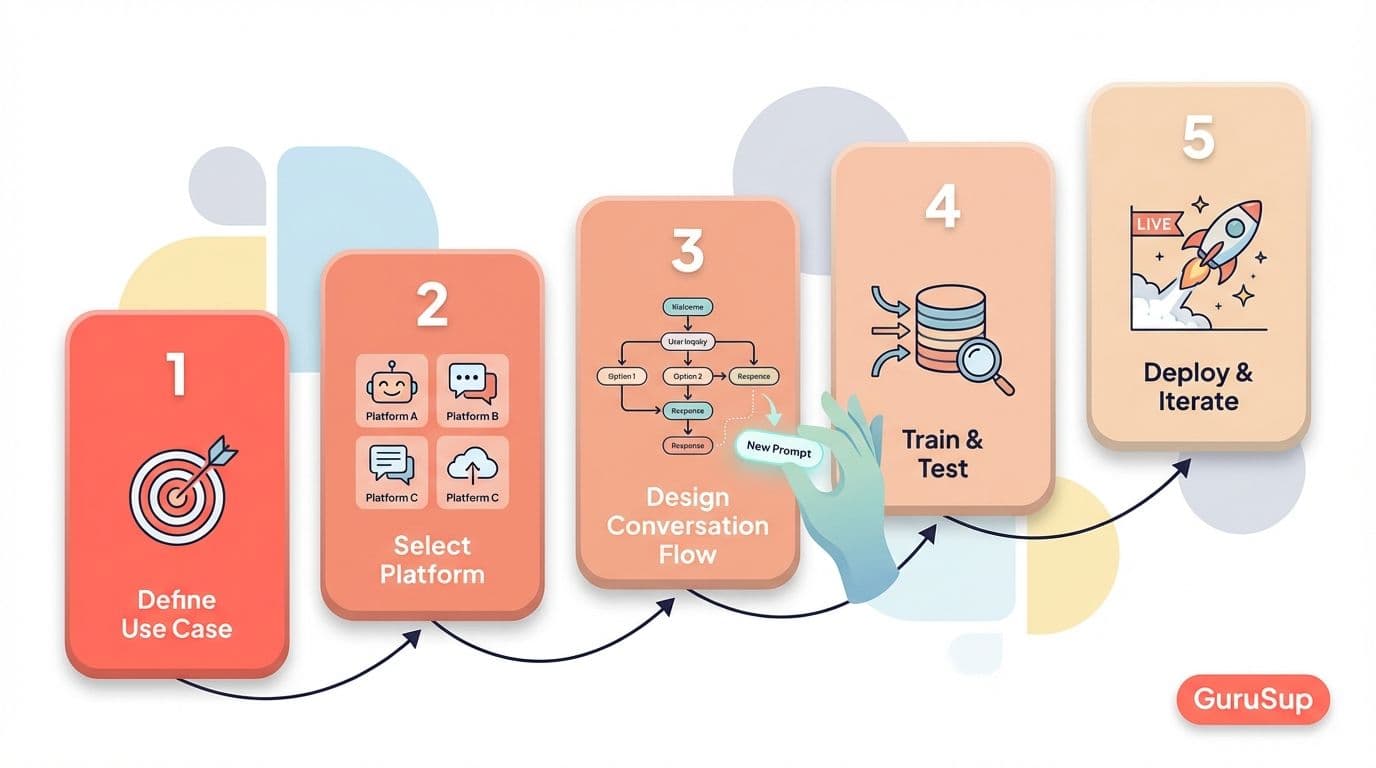
Creating a business chatbot doesn't require programming if you choose the right platform. The process summarizes in five steps: define the use case and priority flows, choose the platform (no-code vs custom), design conversational flows, connect with your systems (CRM, order management, knowledge base), and test exhaustively before launching. The most common mistake is trying to automate everything from day one; start with the 5-10 most frequent queries and expand iteratively.
👉 How to Create a Chatbot: Step-by-Step Tutorial
Chatbot vs AI agent: the evolution
The boundary between chatbots and AI agents has blurred in 2026, but the differences are important. A chatbot answers questions within a defined flow. An AI agent reasons, plans, accesses external tools, and executes actions autonomously. If the chatbot is an ATM (predefined options, limited functions), the AI agent is a digital bank manager who understands your situation and acts accordingly.
The natural evolution for many companies is to start with a hybrid chatbot to resolve frequent queries and evolve towards an AI agent that manages complete processes autonomously. This transition is especially relevant in support automation at scale and in contact center optimization.
👉 AI Agent vs Chatbot: Key Differences
Frequently asked questions
What is a business chatbot?
A business chatbot is conversational AI software that automates communication with customers through digital channels like web, app, or WhatsApp. It uses predefined rules or NLP models to interpret messages and respond autonomously, resolving between 30 and 70% of queries without human intervention.
How much does it cost to implement a business chatbot?
It depends on complexity. Free options: Tidio Free, ManyChat Free, Botpress open-source. Professional platforms: between 30 and 300 EUR/month (Tidio, Intercom, Drift). Enterprise solutions with advanced AI and WhatsApp Business API integration: from 500 EUR/month. GuruSup offers plans adapted to conversation volume.
Can a chatbot replace human agents?
No, and it shouldn't be the goal. The chatbot automates repetitive level 1 queries (40-60% of volume), freeing human agents for complex interactions where empathy and judgment are irreplaceable. The most effective model is hybrid: intelligent automation with fluid escalation to people when the situation requires it.
Want to automate your customer service with an AI chatbot? GuruSup deploys intelligent chatbots on WhatsApp Business and web in weeks, not months. Native Spanish understanding, connection with your CRM, and intelligent escalation to human agents. Start with a pilot, validate the impact, and scale. Discover GuruSup.