






AI Agent: What It Is, How It Works, and What It's Used For [Guide 2026]
What is an AI agent, how it works, and what it's used for. Complete guide with types of agents, architecture, business use cases, and real examples.
 Víctor Mollá5 min read
Updated: May 18, 2026
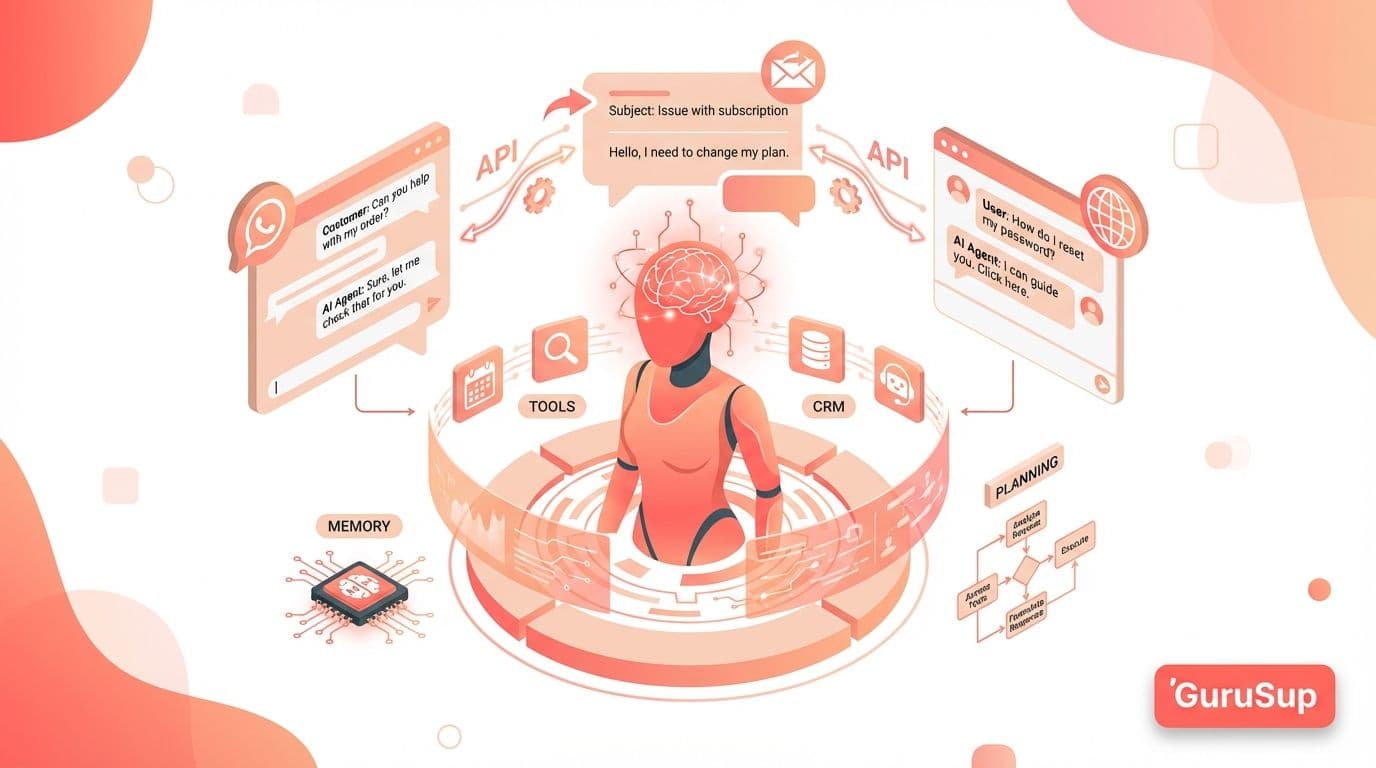
An AI agent is an autonomous software system that uses artificial intelligence to perceive its environment, reason, plan, and execute actions without constant human oversight. Unlike a conventional chatbot, an AI agent combines an advanced language model with external tools, memory, and decision-making capabilities to solve complex tasks independently.
According to Gartner, 33% of enterprise software will incorporate agentic AI capabilities by 2028. This is not a technology of the future — it is the tool already redefining how businesses operate in 2026.
What is an AI agent?
An AI agent is a program that acts autonomously to achieve a goal. It uses language models (LLM) as its central brain, but goes beyond generating text: it can search databases, call APIs, send emails, update a CRM, and decide what the next step should be at any given moment.
The four pillars that define an AI agent are:
- Memory: remembers previous conversations and accumulated context.
- Tools: connects to external systems (APIs, CRM, WhatsApp Business API) to execute real actions.
- Planning: breaks down complex tasks into subtasks and executes them in logical order.
- Autonomy: makes intermediate decisions without requiring human approval for each step.
If you want to dive deeper into the fundamentals, read our guide on what is an AI agent.
How AI agents work
The operating cycle follows the ReAct (Reasoning + Acting) pattern: the agent receives an instruction, reasons about what needs to be done, executes an action with its tools, observes the result, and decides whether the task is complete or another step is needed.
For example, a WhatsApp support agent receives "my order hasn't arrived." Instead of responding with a generic message, it looks up the order number in the CRM, checks the shipping status via the carrier API, detects a delay, generates a personalized message, and offers a discount as compensation. All in under 30 seconds.
Discover the complete technical architecture in how AI agents work.
Types of AI Agents
Not all agents are alike. Depending on their level of autonomy and architecture, different categories exist:
- Reactive agents: respond directly to stimuli without memory or planning.
- Deliberative agents: reason, plan, and maintain internal state.
- Multi-model agents: orchestrate multiple LLMs or specialized tools.
- Collaborative agents: multiple agents work together on complex tasks.
Check out the complete guide on types of AI agents to understand when to use each one.
AI agent vs chatbot: what's the difference?
The most common confusion is equating an AI agent with a chatbot. A traditional chatbot follows predefined scripts — it's like a vending machine. An AI agent reasons, accesses tools, maintains memory, and makes autonomous decisions.
Read the detailed comparison in AI agent vs chatbot: 7 key differences.
Benefits for Businesses
Companies that implement AI agents report measurable results:
- 40-60% reduction in support ticket resolution time.
- 24/7 availability without increasing headcount.
- Instant scalability during demand spikes.
- Consistency in response quality.
Dive deeper into the data in benefits of AI agents for businesses.
How to create an AI agent
Creating your own AI agent in 2026 is more accessible than ever thanks to no-code platforms and orchestration frameworks:
- Define the goal and scope of the agent.
- Choose the LLM (GPT-5.4, Claude, Gemini) based on your use case.
- Connect tools (APIs, databases, communication channels).
- Configure the memory and decision rules.
- Test, measure, and adjust with real data.
Follow the step-by-step tutorial in how to create an AI agent. If you're looking for free options, check out the best free AI agent tools.
Key use cases
- Customer support via WhatsApp: agents that resolve queries, manage orders, and escalate to humans only when necessary. More in AI agent for WhatsApp.
- Automation with n8n: agents connected to enterprise workflows. Tutorial in AI agent with n8n.
- Voice agents: automated phone support with conversational AI. Learn more in AI voice agent.
- Integration with ChatGPT: custom GPTs as specialized agents. Guide in AI agent with ChatGPT.
How guruSup uses AI agents
GuruSup deploys native AI agents on WhatsApp and web that resolve support queries autonomously. Our agents integrate with the customer's CRM, access conversation history, and escalate to a human only when the situation requires it , reducing ticket volume by up to 70%.
Try GuruSup for free and see how an AI agent transforms your customer support.
Frequently asked questions
Can an AI agent replace a human team?
No. AI agents complement human teams by automating repetitive tasks so people can focus on what requires judgment and empathy.
What's the difference between an AI agent and a chatbot?
A chatbot follows fixed scripts. An AI agent reasons, uses tools, maintains memory, and makes autonomous decisions. More details in AI agent vs chatbot.
How much does it cost to implement an AI agent?
It depends on the complexity. With platforms like GuruSup, you can start for free. Custom enterprise solutions vary based on integrations and volume.


