





What is an AI Agent? Definition, Components and Examples [2026]
What an AI agent is, its 4 key components, differences with chatbots and real examples. Updated guide 2026.
 Víctor Mollá6 min read
An AI agent is a software system that uses a language model (LLM) as a brain to perceive its environment, reason, access external tools, and execute actions autonomously without constant human supervision. Unlike a traditional chatbot, an artificial intelligence agent doesn't limit itself to answering questions: it makes decisions, queries databases, and solves complex tasks from start to finish.
According to Gartner, 33% of enterprise software will incorporate agentic capabilities before 2028, versus less than 1% in 2024. In this article I'll explain what composes an AI agent, how it differs from other solutions, and what companies are already getting measurable results. For a broader view on types, tools and how an AI agent works, check out our complete AI agents guide.
AI agent definition
The concept isn't new. In 1995, Russell and Norvig defined an intelligent agent as "any entity that perceives its environment through sensors and acts on it through actuators". The definition remains valid, but the technology that makes it possible at enterprise scale has radically changed.
For decades, agents were rule-based manual systems. If the user says X, respond Y. Each scenario had to be explicitly programmed, limiting their usefulness to predictable flows. The arrival of NLP improved language understanding, but without real reasoning capacity. The inflection point came with the transformer architecture, the technical foundation behind OpenAI's GPT-5.4, Anthropic's Claude, Google Gemini, and Meta's Llama. A modern LLM can reason about situations that were never programmed, exponentially expanding the range of application.
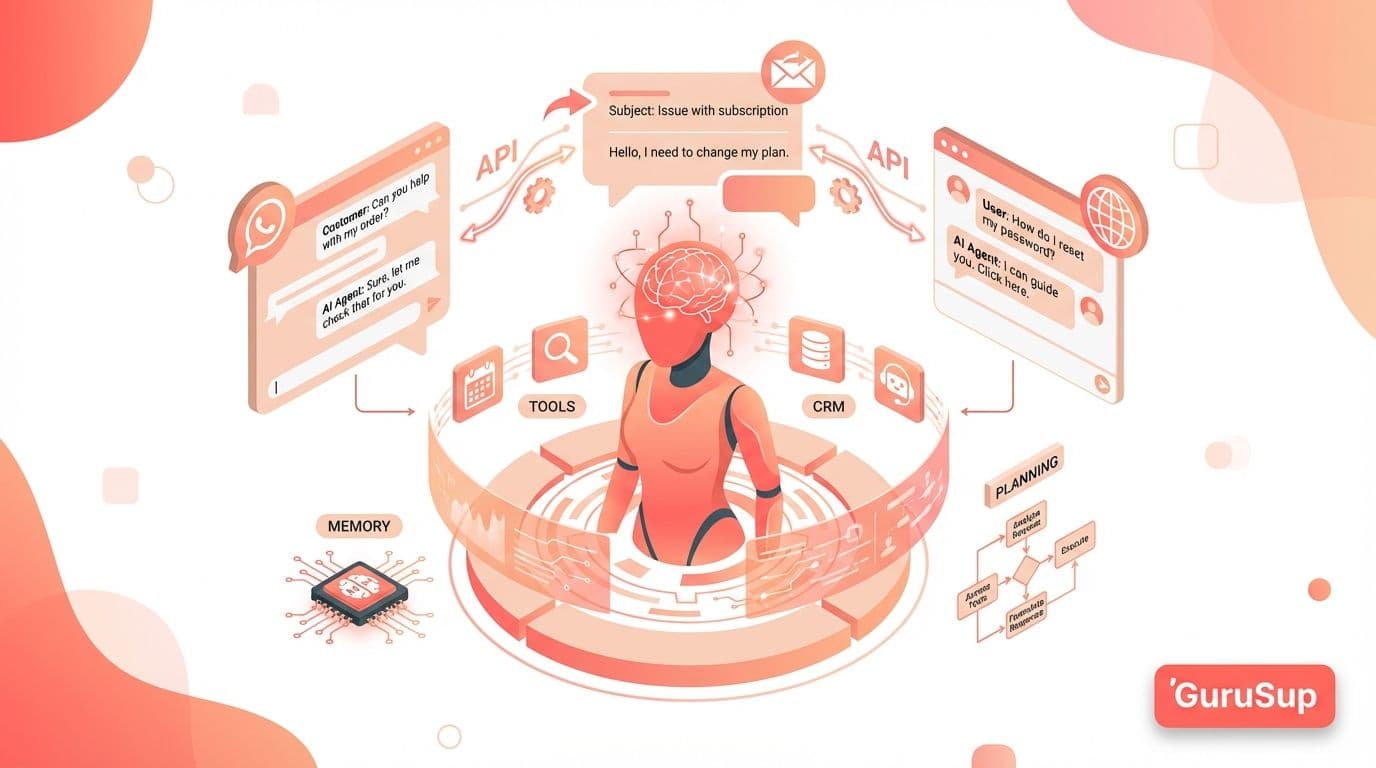
In 2026, when we talk about AI agent in a business context, we refer to something concrete: a system that combines an LLM as a reasoning engine with access to external tools (APIs, CRM, messaging channels), memory of previous interactions, and planning capacity to decompose complex tasks into executable steps. It's not a loose language model that generates text. It's a model with hands, memory, and judgment to act.
The 4 key components
Every functional AI agent is built on four pillars. Remove any one and what remains is something much more limited.
Memory
Memory allows the agent not to start each conversation from scratch. Short-term memory corresponds to the LLM's context window: information from the current conversation. Long-term memory is implemented through vector databases like Pinecone or ChromaDB, storing embeddings of past conversations and internal documents.
Example: a customer contacts for the third time about the same shipping problem. Without memory, the agent asks for data from scratch. With it, it retrieves the history, identifies the recurring case, and escalates with all context.
Tools
Tools are the mechanism by which the agent goes from "understanding" to "doing". A tool can be an API to query orders, a CRM connection, a code interpreter, or an integration with WhatsApp Business API. The key aspect is function calling: the LLM dynamically decides when and which tool to use based on conversation context. This differentiates it from a chatbot with predefined buttons.
Planning
Planning allows decomposing a complex task into subtasks and executing them in logical order. Techniques like Chain-of-Thought force the model to reason step by step before acting.
Example: a customer asks "cancel my subscription and refund what corresponds". The agent decomposes: (1) identify the user, (2) query the active subscription, (3) calculate the proportional amount, (4) process the cancellation, (5) confirm to the customer. Without planning, it would fail trying to solve everything at once.
Autonomy
Autonomy is the ability to make decisions without human approval at each step. But total autonomy isn't the goal. The most effective model in 2026 is human-in-the-loop: the agent operates independently for standard tasks and escalates to a human when it detects a frustrated customer, a case outside its scope, or a high-impact decision. Companies getting the best results design degrees of autonomy: resolve information queries alone, process returns up to a certain amount without approval, but require human validation for exceptions.
AI agent vs chatbot vs virtual assistant
Equating an AI agent with a chatbot or virtual assistant is the most common mistake. All three "talk" with users, but their capabilities are radically different.
| Characteristic | Chatbot | Virtual Assistant | AI Agent |
|---|---|---|---|
| Technology base | Rules, decision trees | Basic NLP + rules | LLM + tools + memory |
| Memory | No memory between sessions | Limited to session | Short and long term (vector database) |
| Tools | None | Predefined functions | Dynamic access to APIs, DBs, code |
| Planning | None | None | Complex task decomposition |
| Autonomy | Fixed scripts | User commands | Decides and acts by itself |
| Resolution | 20-40% | 30-50% | 70-85% |
The analogy: a chatbot is a vending machine. You insert a predefined question, press a button, and always get the same result. If you ask for something off the menu, it doesn't know what to do. A virtual assistant is a receptionist with limited functions. An AI agent is a qualified employee with access to the company's systems and judgment to make decisions.
The economic argument closes the debate: a business chatbot resolves between 20 and 40% of queries. A well-configured artificial intelligence agent reaches 70-85%, reducing the human team's load and improving customer satisfaction.
👉 AI Agent vs Chatbot: Key Differences
Real examples
Theory is validated with data. Four examples of AI agents generating measurable results.
Klarna
Klarna implemented an AI agent for customer service that handles the equivalent work of 700 human agents. Average resolution time went from 11 minutes to 2, with satisfaction levels equivalent to the human team. They didn't replace people: they relocated them to higher-value tasks while the agent absorbed repetitive volume.
Drift and Salesforce
Drift (now part of Salesforce) pioneered conversational sales agents. Companies that implemented them reported a 67% increase in qualified lead conversion. The differentiating factor: an agent that responds in seconds versus the hours a salesperson takes to handle a form. In B2B sales, that speed is decisive.
GitHub copilot
GitHub Copilot works as a development agent that understands a project's context, writes code, runs tests, and proposes refactorings. According to GitHub data, developers complete tasks 55% faster. It's gone from autocompleting code to receiving high-level specifications and delivering functional solutions.
GuruSup
GuruSup deploys AI agents for WhatsApp integrated with WhatsApp Business API. Its agents understand customer intent through advanced NLP, access the company's systems (CRM, order database, knowledge base), and autonomously resolve between 65 and 75% of queries. When the case exceeds their capabilities, the conversation transfers to a human with all context. Companies report a reduction in first response time from hours to seconds and an average 35% savings in support automation costs.
Conclusion
An AI agent is an autonomous system with memory, tools, planning, and autonomy that goes far beyond a chatbot. Data from Klarna, Salesforce, and GitHub demonstrate it's not a future promise, but technology with measurable results today. To dive deeper into types of AI agents, creating your own agent, or exploring free options, check out our complete AI agents guide.
GuruSup lets you deploy AI agents on WhatsApp and web in weeks, not months. No custom development, with direct CRM integration and native Spanish support. Try GuruSup free and discover how many queries your agent can resolve autonomously.