





Best AI for Business: 2026 Selection Guide
Discover the best AI for business in 2026: table by department, selection criteria, SMB tools and estimated ROI. Practical guide.
 Víctor Mollá7 min read
Updated: June 22, 2026

Why every company needs AI in 2026
The debate over whether to adopt artificial intelligence is over. According to McKinsey, 75% of companies globally already use or actively experiment with AI in at least one business function. We're not talking about competitive advantage; we're talking about operational survival. Organizations that don't integrate AI for business tools into their workflows will fall behind--not in five years, but in the next twelve months.
In the business world, SMBs are starting to accelerate adoption. The entry cost has plummeted: what two years ago required a Machine Learning team and six-figure budgets, today is solved with accessible APIs and specialized platforms that don't demand deep technical knowledge. The barrier is no longer technological or economic; it's knowledge. Companies that understand which tool to apply to each specific problem get measurable results in weeks. Those that adopt AI without criteria--because "we need to have AI"--waste time and money.
This guide helps you choose the best AI for business according to your department, budget, and real needs. No smoke, no hype, with data. For a broader context of the tool ecosystem, check our AI comparisons.
Best AI by department: comparison table
There's no AI that does everything well. Each department has different needs and, therefore, the optimal tool varies. This table summarizes the best options by functional area in 2026.
| Department | Best AI | For what | Indicative price |
|---|---|---|---|
| Customer service | GuruSup | AI agents on WhatsApp, automatic query resolution, escalation to humans | Contact |
| Marketing | ChatGPT / Jasper | Content generation, personalized emails, campaign copies | 20-49 $/month |
| Sales | HubSpot AI / Salesforce Einstein | Lead scoring, CRM enrichment, close prediction | 50+ $/month |
| HR | Eightfold / Paradox | Automated recruiting, candidate screening, onboarding | Enterprise |
| Legal | Harvey AI / Claude | Contract analysis, clause review, due diligence | Enterprise |
| Finance | Datarails / Vena | Automated reporting, forecasting, financial consolidation | Enterprise |
| Development | Cursor / GitHub Copilot | Code assistance, automated testing, documentation | 10-20 $/month |
Some clear patterns. For functions involving direct customer communication--support, sales--AI needs to be conversational and integrated into the channels where you already operate. For analytical functions--finance, legal--the model must be accurate and capable of processing large document volumes. For creative functions--marketing, development--generation speed and output quality are decisive factors.
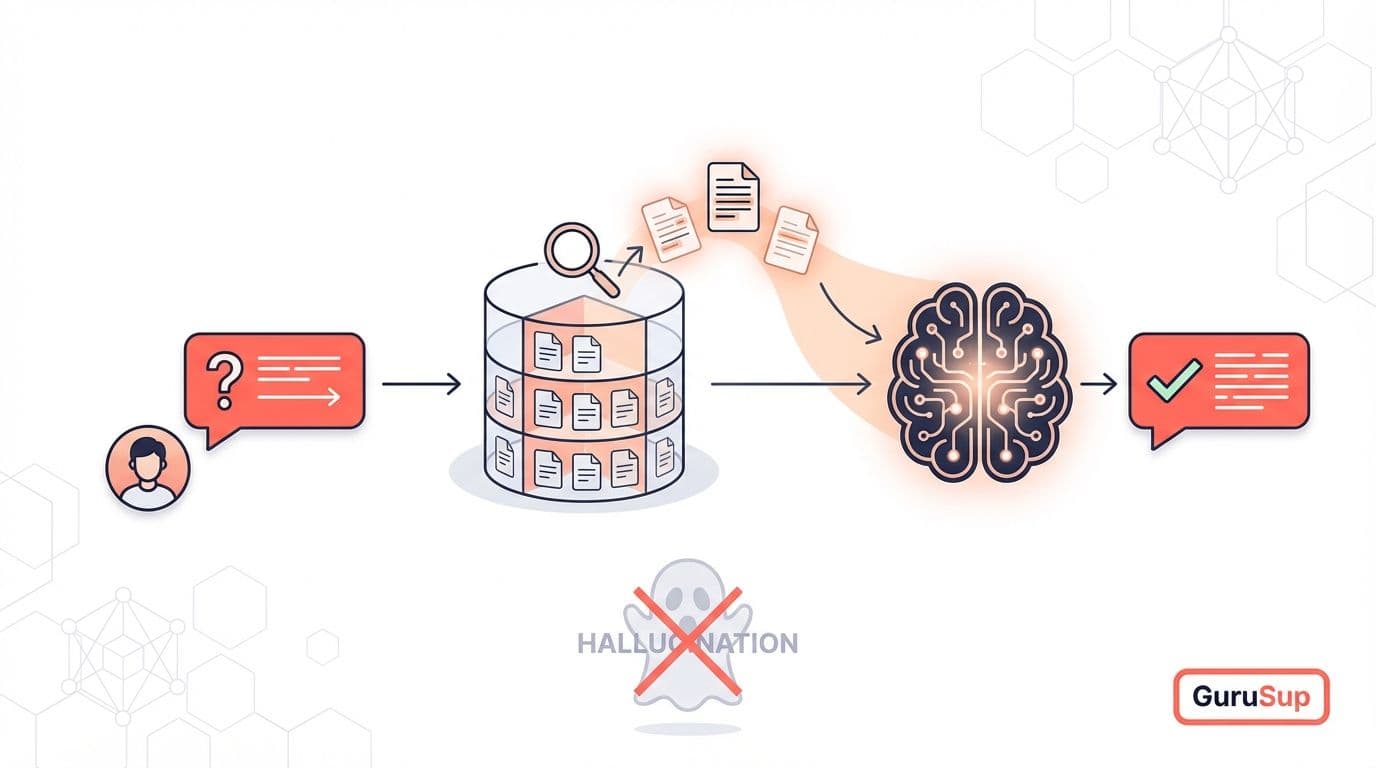
GuruSup stands out in customer service because it's not a generic chatbot: it deploys AI agents that access your knowledge base, understand the context of each conversation, and operate directly on WhatsApp--the channel where your customers already are. It doesn't require users to download anything or change platforms. If you want to dive deeper into the business chatbot ecosystem, we have a dedicated guide.
5 criteria for choosing enterprise AI
Before contracting any artificial intelligence business tool, evaluate these five criteria. Most implementations fail not because of technology, but because they didn't do this preliminary evaluation.
1. Security and regulatory compliance. If you operate in Europe, GDPR compliance isn't optional. Verify the provider offers certifications like SOC2, that data isn't used to train third-party models, and that EU data residency is an option. For regulated sectors--banking, health, insurance--this is eliminatory.
2. Integration with your existing stack. The world's best AI doesn't help if it doesn't connect with your CRM, ERP, or ticketing platform. Prioritize tools with open APIs, native connectors with the platforms you already use, and proven integrations. An isolated tool generates more work, not less.
3. Total cost of ownership. The license price is just the tip of the iceberg. Add implementation cost, team training, maintenance, API consumption per volume, and your technical team's time. A "cheap" tool that requires three months of integration can be more expensive than a premium one ready to use in a week.
4. Ease of adoption. If the team doesn't use it, it doesn't exist. Look for intuitive interfaces, guided onboarding, and a learning curve that doesn't require a master's in prompt engineering. Tools that integrate into existing flows--like WhatsApp for support--have significantly higher adoption rates than those that require users to learn a new platform.
5. Language support. This is ignored too often. If your customers speak your language, AI should understand and respond naturally--including idioms, regional variations, and cultural context. Not all LLMs handle all languages with the same quality. Test before you buy.
The 3 most impactful aIs for sMBs
For SMBs that want to start with AI without major investments, these three tools offer the greatest impact with the least friction.
1. ChatGPT / Claude for General Productivity
Email drafting, meeting summaries, data analysis, report generation, structured brainstorming. ChatGPT and Claude cover 80% of general productivity tasks for 20 $/month per user. ROI is immediate: if each employee saves 30 minutes a day, a 10-person company recovers over 100 hours per month.
2. guruSup to automate support
Customer support is the department where AI generates the fastest and most measurable return. GuruSup deploys intelligent agents on WhatsApp that autonomously resolve queries, with access to your knowledge base and transparent escalation to the human team when necessary. Companies implementing this type of solution report 40% to 60% reductions in tickets requiring human intervention. For a complete view, check our customer service software guide.
3. hubSpot AI for marketing and sales
HubSpot has natively integrated AI throughout its ecosystem: content generation, automated emails, predictive lead scoring, and pipeline analysis. For SMBs already using HubSpot as CRM, activating AI features is a matter of one click. Impact is especially noticeable in lead qualification: the sales team stops wasting time with cold contacts and focuses on opportunities with high closing probability.
Frequently asked questions
What's the best AI for SMBs?
Depends on the problem you want to solve. For general productivity, ChatGPT or Claude for 20 $/month. To automate customer service, GuruSup deploys AI agents on WhatsApp without needing technical development. For marketing and sales, HubSpot AI integrates AI directly into the CRM. The recommendation is to start with the department with the highest volume of repetitive tasks: that's where ROI will be fastest and most visible.
Is it safe to use AI with customer data?
Yes, if you choose tools with the right certifications. Verify the provider complies with GDPR, offers SOC2, and guarantees your data isn't used to train models. GuruSup, for example, operates with strict European regulatory compliance. For highly sensitive data, on-premise deployment options with open-source models exist that eliminate sending data to third parties.
How much does it cost to implement AI in a company?
From 0 to thousands of euros per month, depending on scope. Productivity tools like ChatGPT cost 20 $/month per user. Specialized platforms like GuruSup for support or HubSpot AI for sales have plans adapted to usage volume. An SMB can start with an investment of 100-500 EUR/month and scale according to results. The important thing is to measure ROI from the first month: hours saved, automatically resolved tickets, qualified leads. If the numbers don't add up in 90 days, change tools, not strategy.
GuruSup is the AI for business designed to automate customer support on WhatsApp. Intelligent agents that understand your customers, access your knowledge base, and escalate to the human team when necessary. Try GuruSup free.