





How to Reduce Support Tickets with AI: 7 Proven Strategies [2026]
7 proven strategies to reduce support tickets with AI: knowledge base, chatbot, AI agent, proactive onboarding. Impact table and key metrics.
 Víctor Mollá6 min read
Reducing support tickets isn't a whimsical goal,it's an operational necessity. Support teams are drowning in repetitive queries that consume time, elevate response times, and burn out agents. And meanwhile, the cost per ticket keeps rising.
The data that summarizes the problem: between 60% and 80% of tickets a support team receives are repetitive queries. Password changes, order status, pricing questions, basic configurations. Questions that already have an answer somewhere, but the customer can't find,or doesn't want to search for. Each of these tickets has a direct cost (agent time, tools, infrastructure) and an indirect cost: while an agent answers for the tenth time how to change the billing address, a customer with a complex problem has been waiting twenty minutes.
The solution isn't to hire more agents. It's to deflect tickets before they're created, resolve incoming ones autonomously, and prevent those that repeat. That's what the seven strategies we present do, all with measurable impact. If you need context on support automation, start with our guide on automating support with AI.
7 strategies to reduce ticket volume
1. Self-Service knowledge base
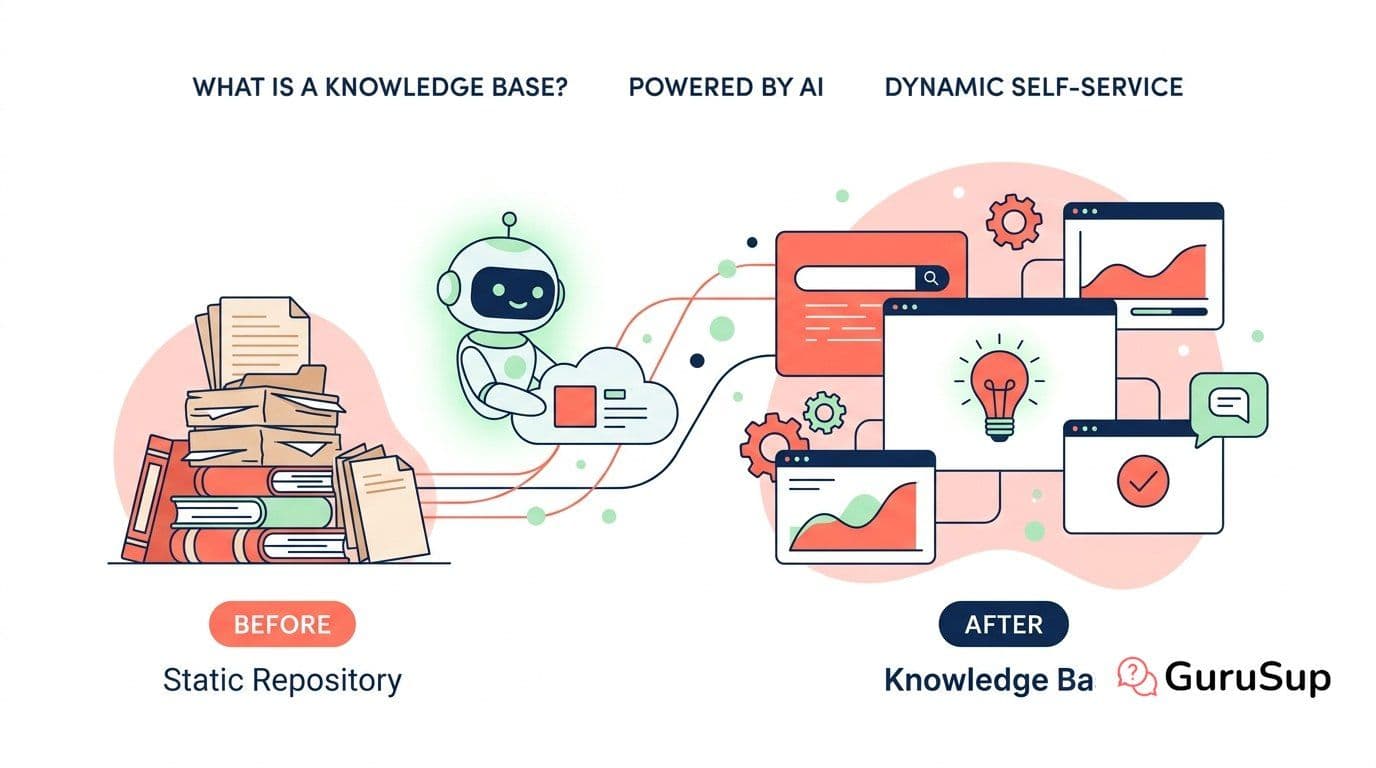
A well-structured Knowledge Base,with FAQs, step-by-step guides, and explanatory videos,is the first line of defense against unnecessary tickets. When the customer can find the answer themselves, they don't open a ticket. That simple. Zendesk reports that companies with mature knowledge base reduce their ticket volume by 20%. The key isn't just creating content, but organizing it so it's findable: powerful internal search, logical categorization, and contextual links within the product.
2. AI chatbot on web and WhatsApp
A Chatbot deployed on your main channels,web and WhatsApp,intercepts queries before they become tickets. The user asks their question, the chatbot responds with accurate information extracted from your knowledge base, and the ticket never exists. That's ticket deflection in its most direct form. Mature implementations deflect between 40% and 60% of incoming volume. To dive deeper into this approach, check out our guide on business chatbot.
3. autonomous AI agent
A step beyond the chatbot. An AI Agent doesn't just answer questions,it executes actions. Processes a return, modifies a reservation, updates account data, all without creating a ticket or involving a human. The difference with a chatbot is autonomy: the agent accesses your systems (CRM, ERP, database) and solves the problem end-to-end. Check out our guide on AI agents to understand this evolution.
4. proactive onboarding
Turn customer support into loyalty and referrals with GuruSup
Soporte con IA que escala sin perder cercanía. Demo de 20 min.
Many support tickets aren't product failures,they're onboarding failures. The customer doesn't understand how a feature works, hasn't completed initial configuration, or is unaware of functionalities that solve their problem. A well-designed customer onboarding process, with guided tutorials, activation messages, and progress checkpoints, eliminates these queries before they're generated. Prevention is always cheaper than resolution.
5. proactive WhatsApp messages
If you know there's going to be a maintenance window on Friday, say so on Wednesday. If you're changing prices, warn before the customer discovers the difference on the invoice. Proactive messages via WhatsApp anticipate questions before they become tickets. Each preventive notice you send is a ticket spike that doesn't materialize. It's the difference between a support team that reacts and one that gets ahead.
6. product improvement based on tickets
Support tickets are a product data mine. If you analyze recurring themes,UX errors, confusing documentation, repeated bugs,and transfer them to the product team, you're attacking the root of the problem. A confusing button that generates 200 tickets per month is fixed with a design change, not with 200 support responses. Establish a monthly ticket analysis cycle where support and product sit down to prioritize improvements.
7. user community or forum
Peer-to-peer support works for non-urgent questions. When experienced users answer new users' questions, you're creating a resolution layer that doesn't consume internal resources. Plus, forum responses get indexed in search engines and organically generate self-service content. It doesn't replace direct support, but it absorbs significant volume of low-urgency queries.
Table: impact by strategy
| Strategy | Estimated Reduction | Implementation Cost | Time to Results |
|---|---|---|---|
| Knowledge Base | 15-25% | Low | 1-2 months |
| AI Chatbot | 40-60% | Medium | 2-4 weeks |
| Autonomous AI Agent | 60-80% | Medium-high | 1-3 months |
| Proactive Onboarding | 10-20% | Medium | 2-3 months |
| Proactive messages (WhatsApp) | 5-15% | Low | Immediate |
| Product improvement | 10-30% | Variable | 2-6 months |
| Community/forum | 5-15% | Low | 3-6 months |
The percentages aren't cumulative,there's overlap between strategies. But a combination of Knowledge Base + AI Agent + proactive onboarding can realistically reduce ticket volume by 70-80%. The sequence matters: start with the chatbot or AI agent (fast and high impact) and build the Knowledge Base and onboarding in parallel.
How to measure ticket reduction
Better customer support starts with GuruSup
Soporte con IA que escala sin perder cercanía. Demo de 20 min.
You can't improve what you don't measure. These are the four metrics you should have on your dashboard:
- Deflection Rate: percentage of queries resolved without generating a ticket. It's the star metric of any ticket deflection strategy. If your chatbot resolves 600 of 1,000 incoming queries, you have a 60% deflection rate. Measure it by channel (web, WhatsApp, email) to know where to invest.
- Ticket Volume Trend: evolution of ticket volume over time, segmented by category. A global decrease is good; a decrease in specific categories (those you've automated) confirms the strategy works.
- First Contact Resolution (FCR): percentage of tickets resolved in the first interaction. If you're deflecting the easy ones, the remaining ones should be more complex, which may temporarily lower FCR. It's normal and expected; don't be alarmed.
- Self-Service Ratio: proportion of queries resolved by self-service (Knowledge Base, chatbot, forum) versus total. A ratio above 60% indicates your deflection strategy is mature.
Set up a dashboard that crosses these four metrics with CSAT to ensure ticket reduction doesn't deteriorate customer experience. Reducing tickets at the cost of frustrating users isn't a victory.
Frequently asked questions
How many tickets can be reduced with AI?
Mature implementations of AI Agent + Knowledge Base reduce between 60% and 80% of incoming tickets. The exact number depends on your product's complexity and the quality of the knowledge base feeding the agent.
Does reducing tickets affect customer satisfaction?
On the contrary. If deflection is done well,with accurate and immediate responses—CSAT goes up. Customers prefer to solve their problem in 30 seconds with a chatbot than wait 20 minutes to talk to an agent. Risk appears only when the chatbot doesn't properly escalate to a human.
What's the fastest strategy to start?
An AI Chatbot deployed on WhatsApp and web. It's the one offering greatest impact in least time: 2-4 weeks of implementation to start deflecting 40-60% of repetitive queries. From there, you evolve toward an autonomous AI Agent that not only responds but executes actions.
GuruSup reduces 80% of support tickets with AI agents deployed on WhatsApp—no code, with autonomous resolution and transparent escalation to the human team. Stop drowning in repetitive tickets. Try GuruSup free and see the impact in the first week. For a complete view of support automation, check out the guide on customer support automation and our introduction to customer success.