





AI Agent vs Chatbot: 7 Key Differences You Need to Know [2026]
AI agent vs chatbot: discover the 7 key differences in memory, autonomy, tools and results. With comparison table and real data.
 Víctor Mollá6 min read
An AI agent and a chatbot are not the same thing, although the market constantly confuses them. Both "talk" to users, but the comparison ends there. A traditional chatbot follows a fixed script; an artificial intelligence agent reasons, accesses external systems, and makes decisions on its own. In this article we break down the seven differences that determine which one solves your problem and which one complicates it. If you need prior context, check our complete guide to AI agents.
Comparison table: AI agent vs chatbot
| Feature | Chatbot | AI Agent |
|---|---|---|
| Technological base | Rules, decision trees | LLM + tools + memory |
| Memory | No memory between sessions | Short term (context window) + long term (vector database) |
| Tools | None | APIs, CRM, databases, WhatsApp Business API, code |
| Planning | Follows fixed script | Decomposes complex tasks (Chain-of-Thought) |
| Autonomy | Rigid, only predefined paths | Decides and acts within guardrails |
| Learning | Manual tree edits | Fine-tuning, RAG, prompt engineering |
| Resolution rate | 20-40% | 70-85% |
| Typical example | FAQ with buttons | Cancel order, calculate refund and notify customer |
7 key differences explained
1. Technological Base
A traditional chatbot works with decision trees: if the user says X, respond Y. Each scenario is programmed manually. When the user goes off-script, the chatbot doesn't know what to do and shows a generic message like "I didn't understand your query".
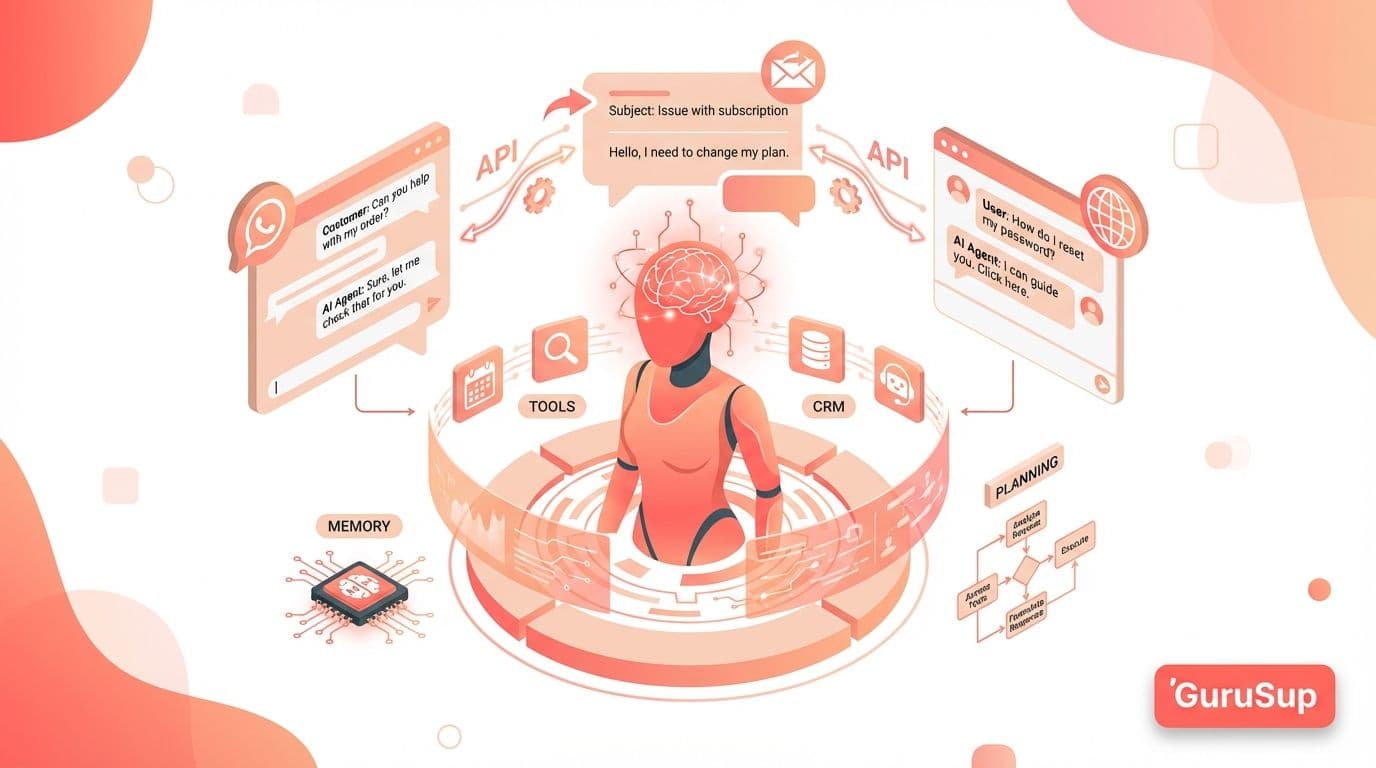
An AI agent uses an LLM as a brain: models like OpenAI's GPT-5.4, Anthropic's Claude, or Google Gemini that understand natural language, interpret ambiguous intentions, and generate coherent responses to situations that were never programmed. The LLM is complemented with tools and memory, creating a system capable of reasoning about new problems. To understand the complete architecture, check how AI agents work.
2. Memory
A chatbot starts each session from scratch. It doesn't remember that the customer called yesterday about the same problem. It has no previous context nor ability to connect interactions.
An AI agent operates with two levels of memory. Short-term memory corresponds to the LLM's context window: all information from the active conversation. Long-term memory is implemented through a vector database like Pinecone or ChromaDB, where embeddings of past interactions and internal documents are stored. Result: when a customer contacts for the third time, the agent knows the entire history, identifies the recurring pattern, and resolves without asking for data it already has.
3. Access to Tools
A chatbot only generates text. It doesn't query databases, doesn't update records, doesn't send messages to other channels. If the user needs something that involves a real action in an external system, the chatbot transfers to a human.
An AI agent accesses tools through function calling: REST APIs, CRM, order management systems, payment gateways, the WhatsApp Business API, and even code interpreters for real-time calculations. The LLM dynamically decides which tool to use based on context. It doesn't need a predefined button for each action. If you want to see how it integrates with real channels, check our article on chatbots for business.
4. Planning
A chatbot follows a linear script. It cannot decompose a complex request into intermediate steps because it has no reasoning capability.
An AI agent uses techniques like Chain-of-Thought to reason step by step. If a customer asks "cancel my subscription and refund what corresponds", the agent decomposes: (1) identify the user, (2) query the active subscription, (3) calculate the proportional amount, (4) process the cancellation, (5) initiate the refund, (6) confirm to the customer. This planning capability is what allows resolving multi-step tasks without human intervention.
5. Autonomy
A chatbot depends on predefined paths. It only operates within scenarios someone explicitly programmed. Outside those paths, it gets blocked.
An AI agent has graduated autonomy. It operates independently for standard tasks and escalates to a human when it detects a case outside its scope, a frustrated customer, or a high-impact decision. The human-in-the-loop model allows defining exactly what it can resolve alone and what requires supervision. It's not total autonomy nor absolute rigidity: it's a configurable spectrum that adjusts to each company's policy.
6. Learning Capability
Improving a chatbot requires manually editing the decision tree, adding new branches, and testing each change one by one. It's a slow and fragile process: each modification can break existing flows.
An AI agent improves through several paths. Prompt engineering allows refining behavior by adjusting system prompt instructions. Fine-tuning trains the model with domain-specific data. And RAG (Retrieval-Augmented Generation) connects the agent with updated knowledge bases without needing to retrain the complete model. The result is a system that improves iteratively with each feedback cycle. To create one from scratch with these capabilities, check how to create an AI agent.
7. Measurable Results
This is where the difference stops being theoretical and becomes economic. A traditional chatbot resolves between 20 and 40% of incoming queries. The rest are transferred to human agents, with the cost and wait time that implies.
A well-configured AI agent resolves between 70 and 85% of queries autonomously. IBM puts the savings at 5.50 euros per automated interaction. For a company with 10,000 monthly queries, that's over 50,000 euros per month in operational savings. ROI is measured in weeks, not years. Klarna's data confirms it: their agent reduced average resolution time from 11 to 2 minutes with satisfaction levels equivalent to the human team.
When to choose a chatbot and when an AI agent
You don't always need an agent. If your company receives less than 500 queries per month, they're all frequently asked questions with fixed answers, and you don't need integration with any external system, a chatbot with a well-designed decision tree is sufficient. It's cheaper, faster to implement, and serves its function.
You need an AI agent when volume exceeds 500 monthly queries, when customers ask questions that don't fit in an options menu, when you need to query CRM or order systems in real-time, or when you operate in multiple channels and languages. The analogy: a chatbot is a vending machine. You enter a predefined option and always get the same result. An AI agent is a qualified employee with access to the company's systems and judgment to resolve whatever comes up. To go deeper into customer support automation, we have a dedicated guide.
Conclusion
The seven differences between an AI agent and a chatbot are summarized in one: ability to solve real problems autonomously. Technological base, memory, tools, planning, autonomy, learning, and measurable results separate a system that responds from one that resolves. If you want to understand the complete ecosystem, start with our guide to AI agents. If you want to see what is an AI agent in detail, we have that covered too.
GuruSup deploys AI agents on WhatsApp that resolve 65-75% of support queries without human intervention. No decision trees. No button menus. With real reasoning, customer memory, and direct CRM integration. Try GuruSup for free and see the difference between a chatbot and an agent that actually resolves.