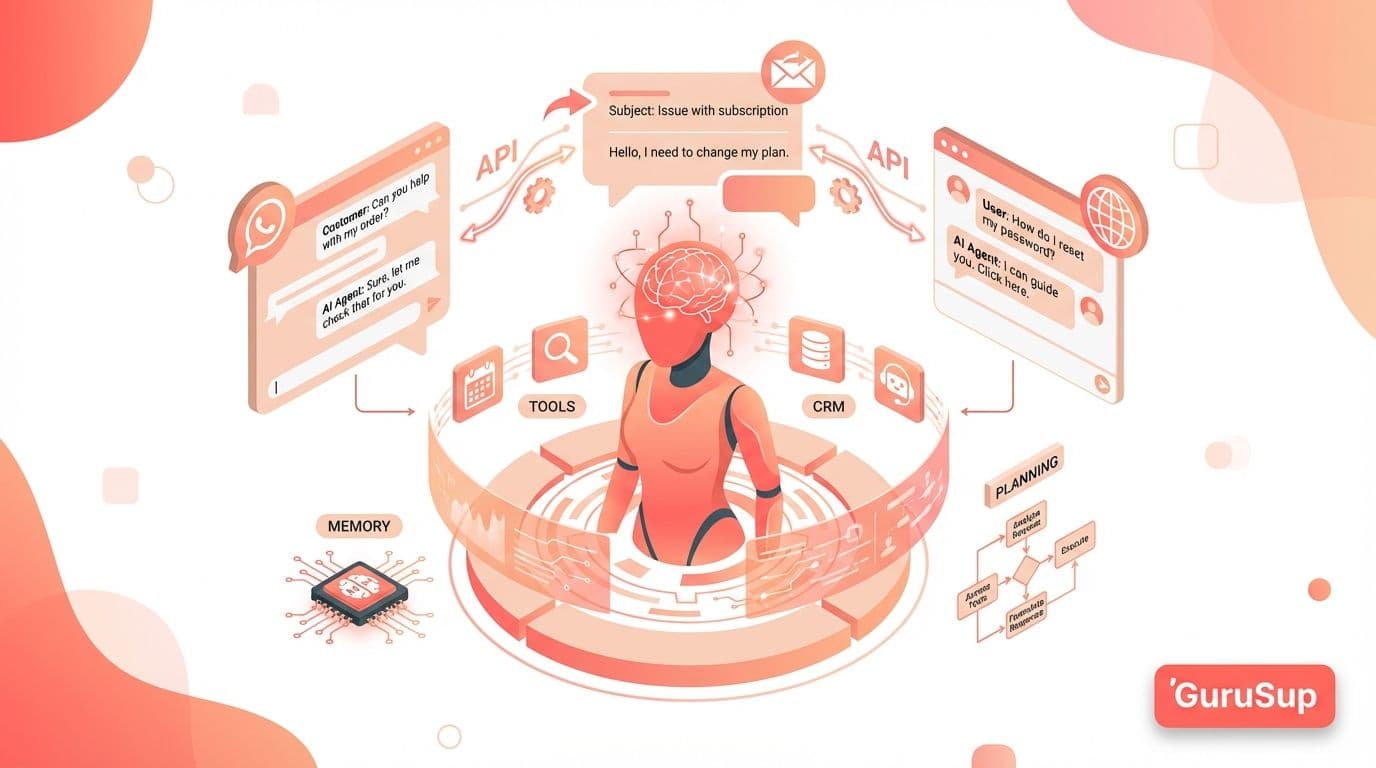






How AI Agents Work: Architecture and ReAct Cycle [2026]
Discover how AI agents work from the inside: the ReAct cycle, the 5 components and the role of prompt engineering.

Updated: June 14, 2026

An AI agent works through an iterative loop where it perceives an input, reasons about it, executes an action with external tools and observes the result before deciding the next step. This cycle, known as ReAct, is what separates an agent from a simple language model that generates text. In this article you'll understand the five internal components of an AI agent's architecture, how the ReAct cycle operates with a real example and why prompt engineering determines whether your agent resolves 50% or 80% of queries. If you're looking for a general definition first, check our complete AI agents guide.
The 5 components of the architecture
Every functional AI agent is built on five components that work in coordination. Remove any one and what you get is a system incapable of operating with autonomy.
The LLM as central brain
The LLM (Large Language Model) is the agent's reasoning engine. Models like GPT-5.4 from OpenAI, Claude from Anthropic, Google Gemini or Llama from Meta understand natural language instructions and decide what action to take next. The LLM doesn't store data or execute code by itself: it reasons about what to do and in what order. The choice of base model directly impacts reasoning quality, ability to follow complex instructions and operational cost per processed token.
Short-term and long-term memory
Memory is what allows the agent not to start each conversation from scratch. Short-term memory corresponds to the LLM's context window: all information from the active session. Long-term memory is implemented through vector databases like Pinecone or Weaviate, where embeddings are stored , numerical representations of past conversations and internal documents. When a customer returns, the agent retrieves their complete history and offers a personalized experience without asking for data again.
Tools
Tools are the mechanism that transforms the agent from "understanding" to "doing". A tool can be a REST API to check orders, a CRM connection, a code interpreter for calculations or an integration with the WhatsApp Business API to send messages. The LLM decides when and which tool to use through a protocol known as function calling (or tool use). This mechanism is what differentiates an AI agent from a chatbot: the chatbot responds with text; the agent executes real actions in external systems.
Planning
Planning is the ability to decompose a complex task into manageable subtasks. Techniques like Chain-of-Thought prompting force the model to reason step by step before acting. If a customer requests "cancel my subscription and refund me proportionally", the agent decomposes: identify user, check active subscription, calculate amount, process cancellation, initiate refund and confirm. Without planning, it would try to resolve everything at once and fail.
Perception
Perception goes beyond literal text. It includes intent analysis (does the user want information or to execute an action?), sentiment detection (are they frustrated?), entity extraction (names, order numbers, dates) and conversational context understanding. In advanced agents, perception also covers multimodal input: images (photo of a defective product), WhatsApp voice messages or attached documents that the agent processes through advanced NLP.
The ReAct cycle: perception, reasoning, action, observation
An AI agent doesn't process requests linearly like a conventional program. It operates in an iterative loop called ReAct (Reasoning + Acting), a paradigm described by researchers from Google and Princeton University in 2022 and adopted as de facto standard in frameworks like LangChain and LangGraph. The cycle has four phases that repeat until the objective is met.
Step 1 , Perceive. The agent receives a stimulus. A customer writes on WhatsApp: "My order hasn't arrived and I've been waiting three days". The agent analyzes the message: detects a complaint intent, a frustration sentiment and a temporal entity ("three days").
Step 2 , Reason. The LLM evaluates the situation, checks memory to see if there are previous interactions with this customer and generates an action plan. It reasons: "I need to check the order system to verify shipping status. I'll use the order query tool with the customer's phone number as identifier". This step is the internal reasoning , the model "thinks aloud" about what tools it needs and in what order.
Step 3 , Act. The agent executes the action: calls the order management system API and receives a response indicating the shipment has a delay due to an incident at the destination warehouse with a new estimated delivery date.
Step 4 , Observe. The agent evaluates the result. It has the information it needed. But the cycle doesn't end: the agent reasons again. Given the frustration sentiment, it decides to offer a compensatory discount besides informing about the delay. It executes a second action (registers the discount in the CRM) and composes a personalized message for the customer with shipping information, apology and discount code.
This continuous loop is what turns agents into systems capable of solving problems that were never explicitly programmed. A linear program needs you to anticipate every scenario. An AI agent with ReAct reasons about the situation in real time, adapts its behavior and chains multiple actions until reaching the objective. It's the difference between software that follows fixed rules and a system that genuinely solves problems. Frameworks like LangGraph model these flows as directed graphs, allowing you to define conditional paths, loops and human escalation points.
The role of prompt engineering
The system prompt is the agent's DNA. It defines its behavior, its action rules, when to use each tool, how to format responses, when to escalate to a human and what information it should never invent. Well-executed prompt engineering is the difference between an agent that resolves 50% of queries and one that reaches 80%.
The system prompt includes: agent identity (name, tone, language), description of each available tool with parameters and examples, security guardrails (don't share other customers' data, don't approve refunds above certain amount without supervision, don't give legal advice) and escalation rules. All this must fit within the model's context window, which is managed through tokenization , the process of converting text into numerical units the LLM can process. The longer and more detailed the prompt, the less space remains for conversation and memory, forcing a technical balance between exhaustive instructions and operational capacity.
The most effective types of AI agents aren't those using the most powerful model, but those with the best-designed prompt.
Conclusion
An AI agent works by combining five components — LLM, memory, tools, planning and perception — orchestrated by the ReAct cycle of perception-reasoning-action-observation. This iterative loop is what allows it to solve complex problems with autonomy, chaining multiple actions until reaching the objective.
If you want to dive deeper into what an agent is, check what is an AI agent. If you're ready to build one, review how to create an AI agent step by step. And for a complete ecosystem view, our AI agents guide covers types, tools, benefits and use cases.
GuruSup applies this architecture to deploy AI agents on WhatsApp that resolve 65-75% of support queries autonomously, with customer support automation ready in weeks. Try GuruSup for free and see how an AI agent works in your real operation.