






AI Governance Trends 2026
Cinco tendencias en gobernanza IA en 2026: aplicación del EU AI Act, desafíos de IA agéntica, adopción de ISO 42001, leyes estatales en EE.UU.
 Víctor Mollá4 min read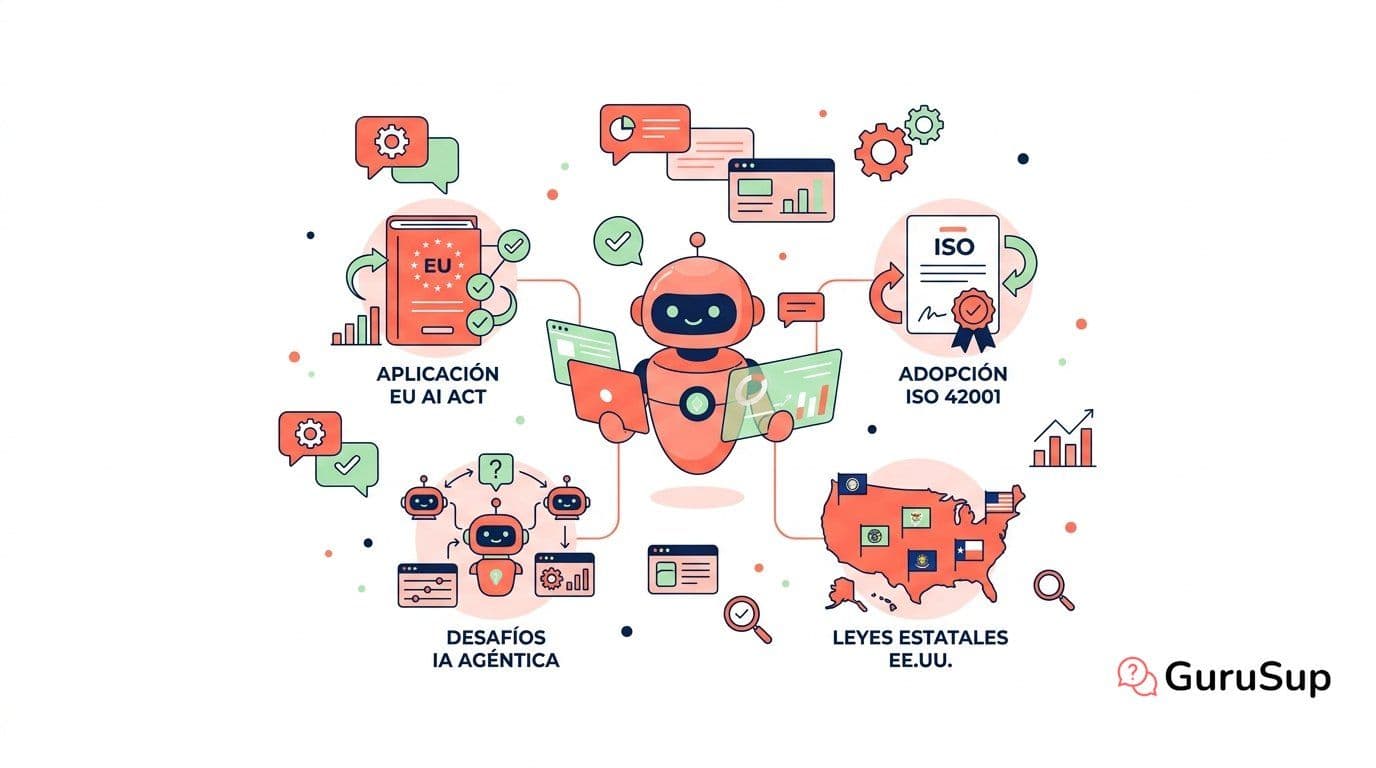
AI governance in 2026 is shifting from planning to execution. The EU AI Act's first enforcement deadlines have passed, ISO 42001 adoption is accelerating, and organizations are discovering that governing agentic AI systems requires entirely new approaches. Here are five trends defining the year.
1. EU AI Act Enforcement Gets Real
The prohibited practices provisions took effect in February 2025. The first enforcement actions are expected in 2026 as national regulators build their inspection capabilities.
What this means in practice:
- Companies still using social scoring, manipulative AI targeting vulnerable groups, or unauthorized real-time biometric surveillance face immediate regulatory risk.
- General-purpose AI model providers must comply with transparency and copyright obligations by August 2025.
- High-risk AI system requirements hit in August 2026 — the compliance window is closing fast.
Organizations that started building their AI governance frameworks early are in strong position. Those starting now have months, not years.
2. Agentic AI Breaks Existing Governance Models
Autonomous AI agents that take actions, use tools, and make sequential decisions do not fit neatly into governance frameworks designed for prediction models or chatbots.
New governance challenges with agentic AI:
- Accountability chains — when an agent calls another agent, which makes an API call, which triggers a purchase, who is responsible for a bad outcome?
- Scope creep — agents with broad tool access can take actions beyond their intended scope. Governance must define and enforce action boundaries.
- Audit trails — traditional logging captures inputs and outputs. Agent systems need trace-level logging of every step, tool call, and decision point.
- Testing at scale — you cannot test every possible path an autonomous agent might take. Governance frameworks need to address probabilistic behavior.
Expect new governance standards specifically for agentic systems to emerge in late 2026.
3. ISO 42001 Adoption Accelerates
ISO 42001 moved from "interesting" to "required" in many enterprise procurement conversations. Our ISO 42001 guide covers the certification process in detail.
Drivers of adoption:
- Enterprise buyers adding ISO 42001 to vendor requirements alongside ISO 27001
- EU AI Act compliance — the standard provides a management system framework that maps to regulatory requirements
- Competitive differentiation — certified organizations win trust and contracts
- Insurance — AI liability insurers are starting to factor governance certifications into risk assessments
4. US State-Level AI Laws Create a Patchwork
While the federal government has not passed comprehensive AI legislation, states are moving independently. Colorado's AI Consumer Protections Act, Illinois' Artificial Intelligence Video Interview Act, and similar laws in California, Texas, and New York create a complex compliance landscape.
For companies operating across states, this patchwork is harder to manage than a single federal framework. The practical response: build governance to the strictest standard and apply it everywhere. This is the same approach that worked for state privacy laws before them.
5. The Governance Role Explosion
In 2024, AI governance was a side responsibility for legal or compliance teams. In 2026, it is becoming a function:
- Chief AI Officer (CAIO) — executive accountability for AI strategy and governance. Mandated for some public sector organizations under the EU AI Act.
- AI Governance Lead — operational owner of governance framework, policies, and compliance.
- AI Ethics Reviewer — conducts impact assessments and reviews high-risk deployments. See our guide on building an AI ethics board.
- AI Auditor — internal and external audit of AI systems against standards and regulations.
- AI Risk Manager — maps AI systems to risk frameworks and monitors emerging threats.
The talent market for these roles is tight. Organizations investing in internal training are better positioned than those competing for a small pool of experienced hires.
What This Means for Your Organization
The window for treating AI governance as optional is closed. Start with these actions:
- Audit your current AI systems against EU AI Act risk categories.
- Build or update your governance framework with agentic AI considerations.
- Evaluate governance tooling to automate compliance monitoring.
- Assign governance roles with clear accountability, even if part-time initially.
- Track regulatory developments — our AI governance signal covers what matters.
AI governance is no longer a cost center. It is the foundation that determines whether your AI investments deliver value or liability.