






AI Leadership Team Structure
How to build an AI leadership team: CAIO, ML engineering, data science, ethics, and product management roles with three reporting structure models.
 Víctor Mollá3 min read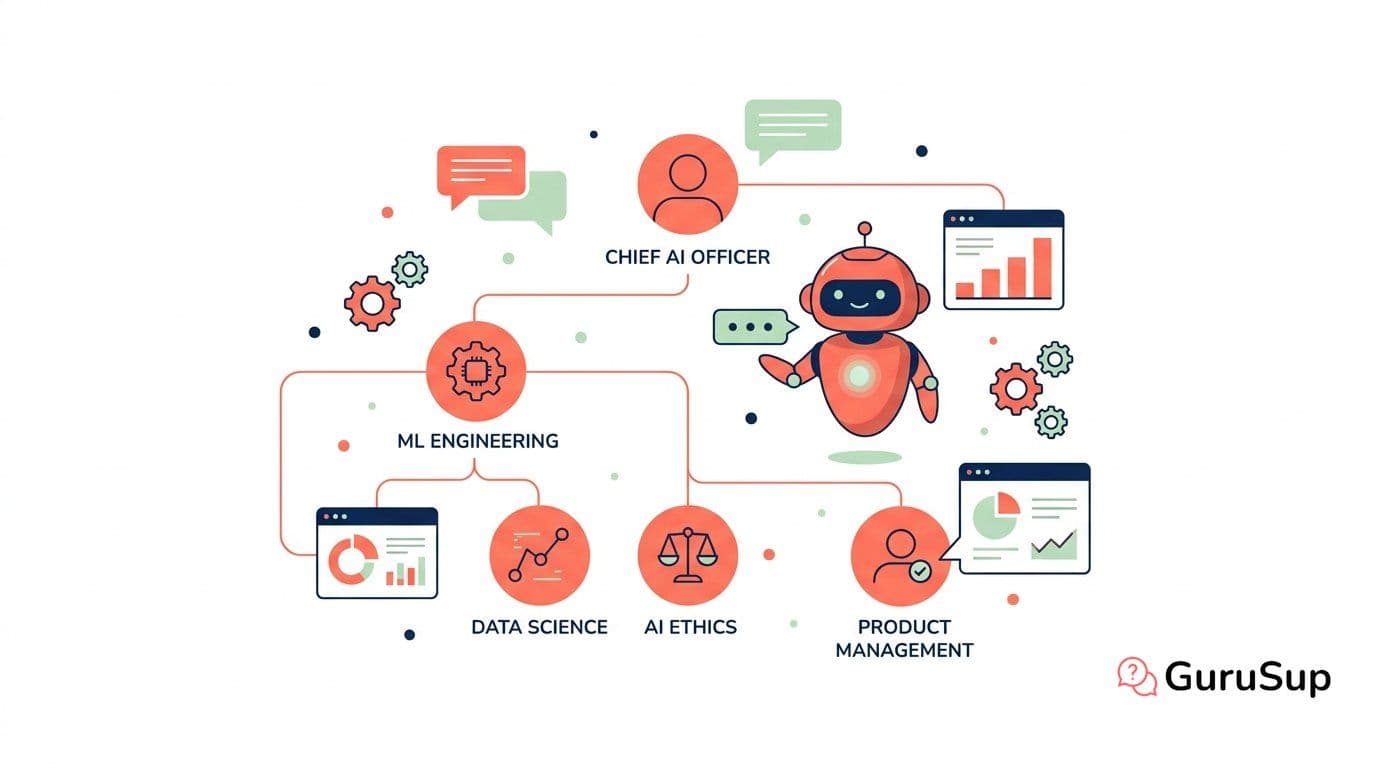
Why Structure Matters for AI Teams
Most AI failures aren't technical. They're organizational. Companies hire data scientists, give them vague mandates, scatter them across departments, and wonder why AI projects stall. A structured AI leadership team fixes this by creating clear ownership, career paths, and decision-making authority.
Here's how to build an AI organization that ships results.
The Core AI Leadership Roles
Chief AI Officer (CAIO)
Owns AI strategy, governance, and executive communication. Reports to CEO. This is the person accountable for whether AI investments generate business value. For a full breakdown of the role, see what a CAIO does.
VP of ML Engineering
Owns model development, MLOps, and production deployment. This person manages the engineers who build and maintain AI systems. They care about model reliability, inference latency, and deployment pipelines.
VP of Data Science
Owns research, experimentation, and model evaluation. This team works on exploring new AI use cases, running A/B tests, and validating business impact. They work closely with product teams to translate business questions into data problems.
AI Ethics and Governance Lead
Owns bias monitoring, compliance, and responsible AI policies. In regulated industries, this role is mandatory. Even in unregulated ones, it prevents the kind of PR disasters that set AI programs back years. This role connects to the broader AI governance framework.
AI Product Manager
Bridges technical AI capabilities and business needs. Defines requirements, prioritizes features, and ensures AI projects solve real user problems rather than interesting technical challenges.
Reporting Structure Options
Centralized Model
All AI roles report to the CAIO, who reports to the CEO. Best for companies where AI is a core part of the business strategy.
- Pros: Clear ownership, consistent standards, efficient resource allocation.
- Cons: Can create an ivory tower disconnected from business units.
Hub-and-Spoke Model
Central AI team sets standards and provides shared services. Embedded AI practitioners sit within business units but have a dotted line to the CAIO.
- Pros: Close to business context, maintains standards through central governance.
- Cons: Requires more coordination, risk of inconsistent practices.
Federated Model
Each business unit has its own AI team. The CAIO sets enterprise-wide policies but doesn't manage individual teams.
- Pros: Maximum business alignment.
- Cons: Duplication of effort, harder to maintain standards, fragmented talent pool.
Team Size Benchmarks
- Startup (< 500 employees): 3-8 AI practitioners. CAIO may be a VP-level role. No dedicated ethics lead needed yet.
- Mid-market (500-5,000 employees): 15-40 AI practitioners. Full CAIO with dedicated governance. Hub-and-spoke model works well.
- Enterprise (5,000+ employees): 50-200+ AI practitioners. Centralized or hub-and-spoke. Dedicated AI ethics board.
Common Mistakes
- Hiring data scientists before having data infrastructure.
- Putting AI under IT rather than giving it executive-level reporting.
- Not creating an AI product management function.
- Letting every team run its own AI experiments without coordination.
The structure should match your AI maturity and business model. Start with a centralized team, then evolve to hub-and-spoke as AI use cases spread across the organization.
For related reading, see how the CAIO role differs from the CTO and what a new CAIO should focus on in their first 90 days.