






Claude vs Gemini: Complete Comparison 2026
Claude vs Gemini: which AI is better in 2026? We compare Claude 4.6 and Gemini 3.1 on pricing, coding, writing, multimodal capabilities, and business use cases side by side.

Updated: September 17, 2026
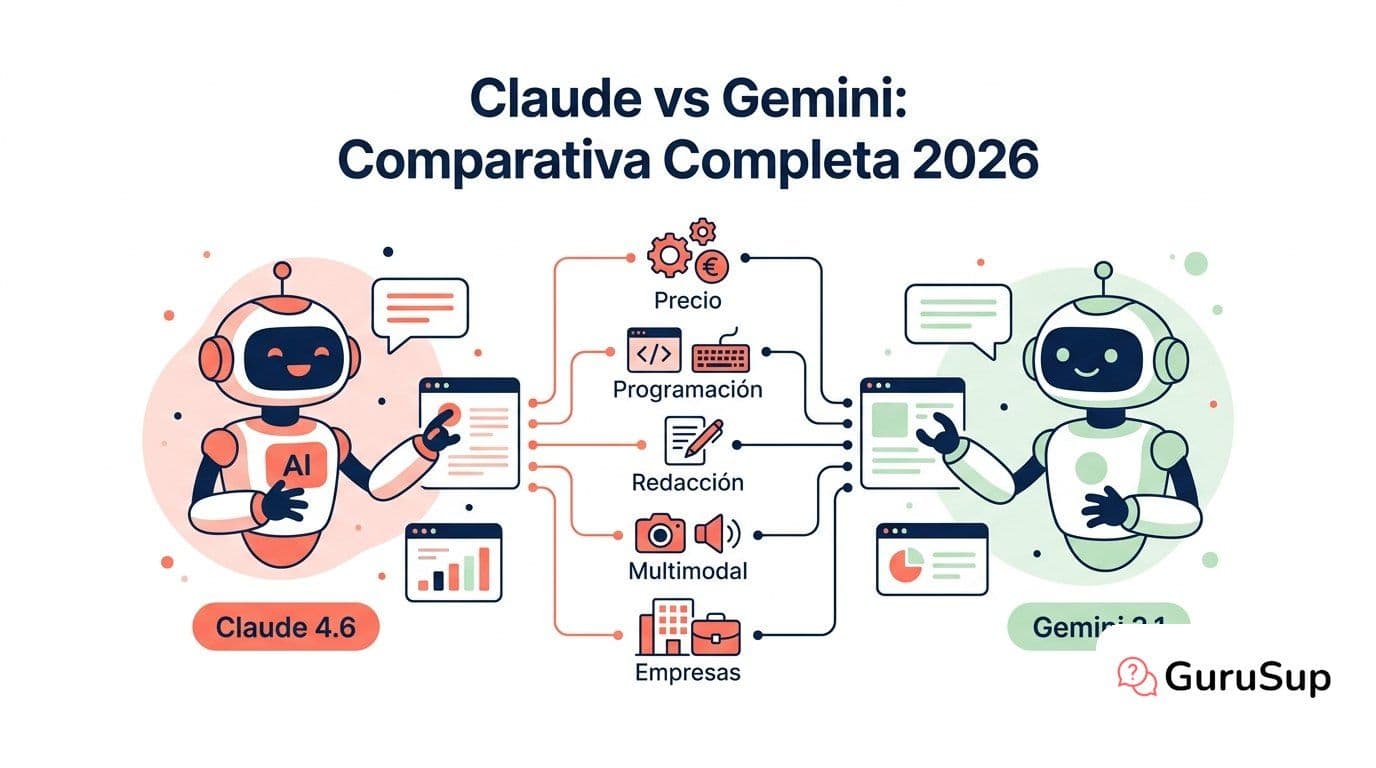
Two AI titans, two very different philosophies. Claude vs Gemini is the comparison every team evaluating AI in 2026 needs to understand — whether you're a developer choosing a coding assistant, a writer seeking nuanced output, or a business leader deploying AI agents at scale.
This guide compares Claude 4.6 (Opus and Sonnet) against Gemini 3.1 (Pro and Flash) across pricing, features, and real-world use cases.
Claude vs Gemini: Quick Overview
| Claude 4.6 | Gemini 3.1
Developer | Anthropic | Google DeepMind
Top model | Opus 4.6 | Pro 2.5
Fast model | Sonnet 4.6 | Flash 2.5
Context window | 200K tokens (1M for Opus) | 1M tokens (standard)
Strengths | Writing, reasoning, code | Multimodal, Google ecosystem
Safety approach | Constitutional AI | Google AI Principles
Both platforms have matured significantly. Claude excels at depth and precision; Gemini wins on breadth and integration.
Pricing [2026]
For individual users, both cost the same at the subscription level:
- Claude Pro: $20/month — access to Opus 4.6 and Sonnet 4.6, extended context, priority access
- Gemini Advanced: $20/month (bundled with Google One AI Premium) — access to Pro 2.5, 1M context, integration with Google Workspace
API pricing is where they diverge:
Model | Input (per 1M tokens) | Output (per 1M tokens)
Claude Opus 4.6 | $15 | $75
Claude Sonnet 4.6 | $3 | $15
Gemini 3.1 Pro | $7 | $21
Gemini 3.1 Flash | $0.15 | $0.60
Gemini Flash 2.5 is the cheapest high-quality model available — ideal for high-volume tasks. Claude Sonnet offers a strong mid-range option for teams that need better reasoning per token.
Features: Reasoning, Coding, Context, Multimodal
Reasoning
Claude 4.6 Opus leads benchmarks in complex reasoning tasks, especially multi-step logic and analysis of ambiguous scenarios. Gemini 3.1 Pro has closed the gap significantly with its "thinking" mode, but Claude remains the model professionals choose for legal analysis, financial review, and research synthesis.
Coding
Both are excellent coding assistants. Claude 4.6 consistently produces cleaner, more idiomatic code and handles large codebases better thanks to its strong instruction-following. Gemini 3.1 Pro performs well on competitive programming benchmarks but can be less consistent in production-grade refactoring tasks.
Context Window
Gemini wins here decisively. 1M tokens standard means you can feed entire codebases, long legal documents, or hours of meeting transcripts. Claude Opus 4.6 supports up to 1M tokens but the standard window is 200K — still generous, but Gemini's default is five times larger.
Multimodal
Gemini 3.1 is natively multimodal — it processes images, video, audio, and code in a single prompt. Claude 4.6 handles images and documents well but lacks native video and audio understanding. If your workflow involves analyzing screenshots, diagrams, or video content, Gemini has a clear edge.
Which for Writing and Analysis?
Claude wins for writing. It produces more nuanced, human-sounding prose with better structure. It follows complex style guides more faithfully and is less likely to produce generic filler. For long-form analysis — market research, competitive intel, document review — Claude's precision with lengthy inputs makes it the preferred choice.
Gemini is adequate for drafting and summarization but tends toward a more formulaic output style.
Which for Coding?
Claude has the edge for professional development. Claude 4.6 Sonnet (via Claude Code or API) excels at understanding project structure, writing tests, and refactoring. It's the model behind many AI-powered coding tools for a reason.
Gemini 3.1 Pro integrates tightly with Google's ecosystem — Android Studio, Colab, Firebase — making it the natural choice for Google-stack developers. For general-purpose coding, Claude is more reliable; for Google-specific workflows, Gemini is more convenient.
Which for Business?
Neither Claude nor Gemini are purpose-built for business operations out of the box. They're general-purpose LLMs that require significant engineering to deploy in production customer-facing scenarios.
For customer support, sales automation, and helpdesk operations, you need more than a raw model — you need AI agents designed for those workflows: routing, escalation, CRM integration, multilingual support, and compliance.
Build AI Customer Support with GuruSup
Instead of wiring together prompts and APIs, GuruSup's AI agents are purpose-built for customer operations. They handle:
- Omnichannel support across WhatsApp, web chat, email, and voice
- Intelligent routing that escalates to human agents when needed
- Multilingual conversations without translation layers
- CRM and helpdesk integration out of the box
Whether you use Claude, Gemini, or any other model under the hood, GuruSup abstracts the complexity so your team focuses on customers, not infrastructure.
FAQ
Is Claude better than Gemini?
It depends on your use case. Claude 4.6 is better for writing, nuanced reasoning, and coding. Gemini 3.1 is better for multimodal tasks, large context windows, and Google ecosystem integration.
Can I use Claude and Gemini together?
Yes. Many teams use Claude for quality-critical tasks (analysis, code review) and Gemini Flash for high-volume, cost-sensitive operations.
Which is cheaper for API use?
Gemini 3.1 Flash is significantly cheaper. For premium models, Gemini 3.1 Pro offers better price-performance while Claude Opus 4.6 delivers higher quality at a higher cost.
Which should I choose for customer support automation?
Neither as a standalone model. Use a platform like GuruSup that deploys purpose-built AI agents for customer operations, regardless of the underlying model.
---
*Related reading: Claude vs ChatGPT | AI Model Comparisons*