






AI Automation Implementation Roadmap
A 5-phase roadmap for AI automation implementation. From assessment to enterprise-wide deployment, with timelines, change management, and mistakes to avoid.
 Víctor Mollá4 min read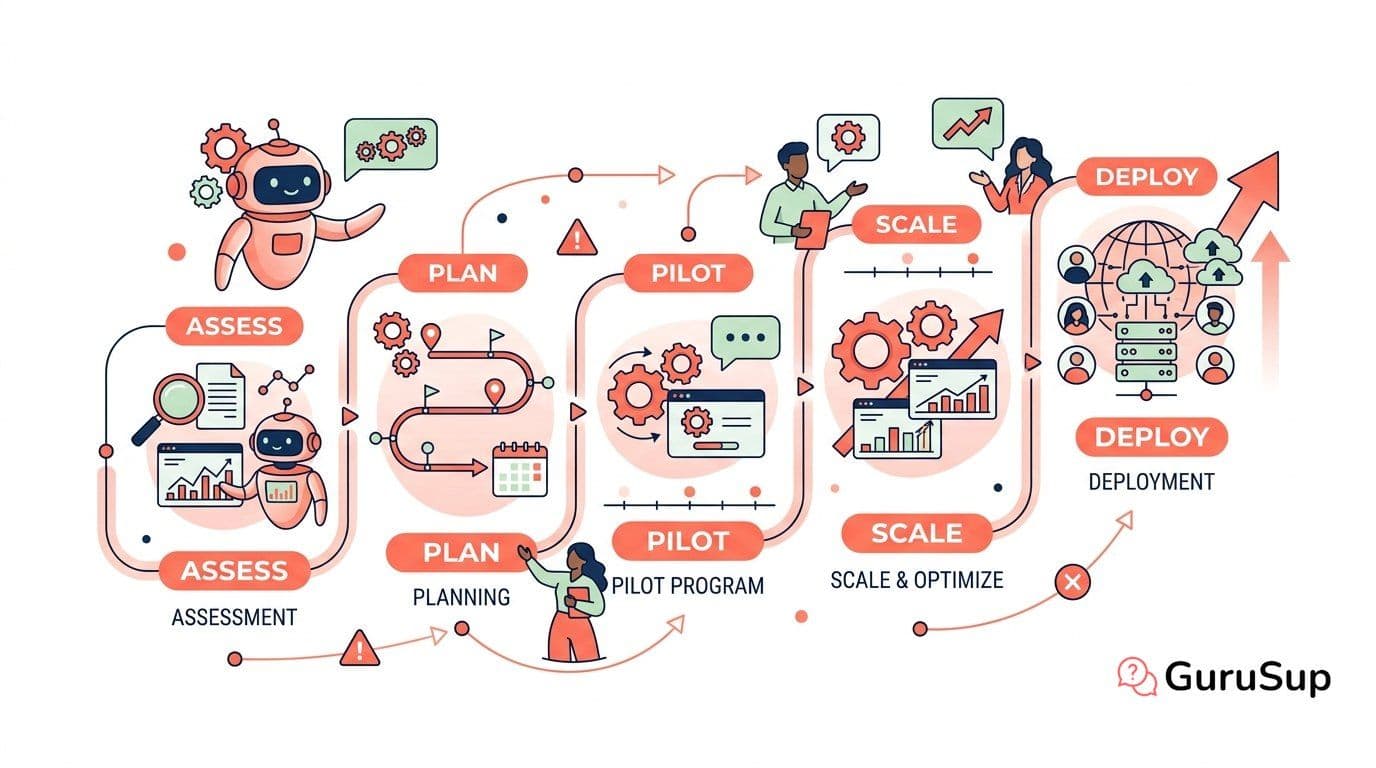
Most AI automation projects fail not because the technology does not work, but because the implementation was wrong. No pilot phase, no baseline measurement, no change management, no governance. Then leadership blames "the AI" and shelves the project.
Here is a 5-phase roadmap that works.
Phase 1: Assessment (Weeks 1-3)
Before touching any AI tool, understand your current state.
Process inventory
List your top 20 processes by volume. For each, document:
- Monthly volume (tickets, transactions, requests)
- Average handling time
- Current cost per unit
- Error rate
- Input type (structured, unstructured, mixed)
Automation readiness scoring
Score each process on four dimensions:
- Volume: Higher volume = higher ROI potential
- Repetitiveness: More repetitive = easier to automate
- Data availability: More historical data = better AI training
- System access: Can the AI read and write to the relevant systems?
Rank by total score. The top 3-5 are your pilot candidates.
Baseline measurement
For your pilot candidate, measure everything before you start. You cannot prove ROI without a before number. See the ROI calculation framework for what to measure.
Phase 2: Pilot (Weeks 4-8)
Scope
Pick ONE process. One channel. A subset of volume (10-20%). Do not try to prove everything in the pilot. Prove that AI automation works for this specific use case.
Setup
- Select your tool (see AI automation tools comparison)
- Connect to relevant systems (CRM, helpdesk, knowledge base)
- Load training data: FAQs, historical tickets, product documentation
- Configure escalation rules: when should AI hand off to humans?
- Set up monitoring: track every AI action, flag errors
Run the pilot
- Week 1-2: Shadow mode. AI generates responses but does not send them. Humans review every one. This builds confidence and catches errors early.
- Week 3-4: Supervised mode. AI sends responses, but a human can intervene. Monitor quality closely.
- Week 5+: Autonomous mode for ticket categories where AI accuracy exceeds 95%. Keep human review for the rest.
Phase 3: Scale (Weeks 9-16)
If the pilot succeeds (and you measured it against the baseline), expand.
Horizontal scaling
- Add more ticket categories / process types
- Increase volume from 20% to 50%, then to 80%
- Add channels (if started with email, add chat, then voice)
Vertical scaling
- Give the AI more system access (write permissions, more integrations)
- Increase the AI's decision-making authority (higher refund limits, more complex actions)
- Reduce human review requirements as accuracy proves out
Phase 4: Optimize (Months 5-8)
Performance tuning
- Analyze where AI fails and why. Common causes: missing knowledge base content, unclear policies, edge cases
- Update training data and knowledge base based on findings
- Refine escalation rules to balance automation rate with quality
Process improvement
AI automation often reveals process problems that existed before. A ticket category that AI handles poorly might have confusing policies that humans also struggle with. Fix the process, not just the AI.
Expansion planning
Identify the next 2-3 processes to automate. Use learnings from the first implementation to accelerate. Each subsequent deployment should be faster than the last.
For real examples of what to automate next, see 20 AI automation examples.
Phase 5: Governance (Ongoing)
Monitoring and reporting
- Weekly reports on automation rate, accuracy, CSAT, and cost savings
- Monthly reviews comparing performance against baseline
- Quarterly ROI updates for leadership
Quality management
- Random audits of AI responses (5-10% sample)
- Customer feedback loops: are automated responses rated differently?
- Error tracking and root cause analysis
AI governance
As AI makes more decisions, governance matters more:
- What decisions can AI make autonomously vs with human approval?
- How do you handle AI errors? Who is accountable?
- How do you ensure compliance with regulations?
- How do you prevent bias in AI decisions?
For a complete governance framework, see our AI governance guide.
Common Mistakes
- Skipping the pilot. Going from zero to full deployment. Always pilot first.
- No baseline. You cannot prove improvement without a before measurement.
- Ignoring change management. Agents feel threatened, managers do not trust the AI, customers are not informed. Address all three.
- Over-automating. Not everything should be automated. Some interactions need a human touch.
- Set and forget. AI needs ongoing maintenance. Knowledge bases change, products change, policies change.
For a deep dive on these and other pitfalls, read AI automation challenges and how to overcome them.
Timeline Summary
- Weeks 1-3: Assessment and process selection
- Weeks 4-8: Pilot deployment and measurement
- Weeks 9-16: Scale to full volume and additional channels
- Months 5-8: Optimize and expand to new processes
- Ongoing: Governance, monitoring, and continuous improvement
Total time from decision to full deployment: 4-8 months for the first process. Each subsequent process: 2-4 months.
Back to the AI Automation hub.