






The ROI of AI Governance
Caso de negocio para gobernanza IA: coste del incumplimiento (multas de 35M€), métricas de ROI, despliegue 5x más rápido.
 Víctor Mollá4 min read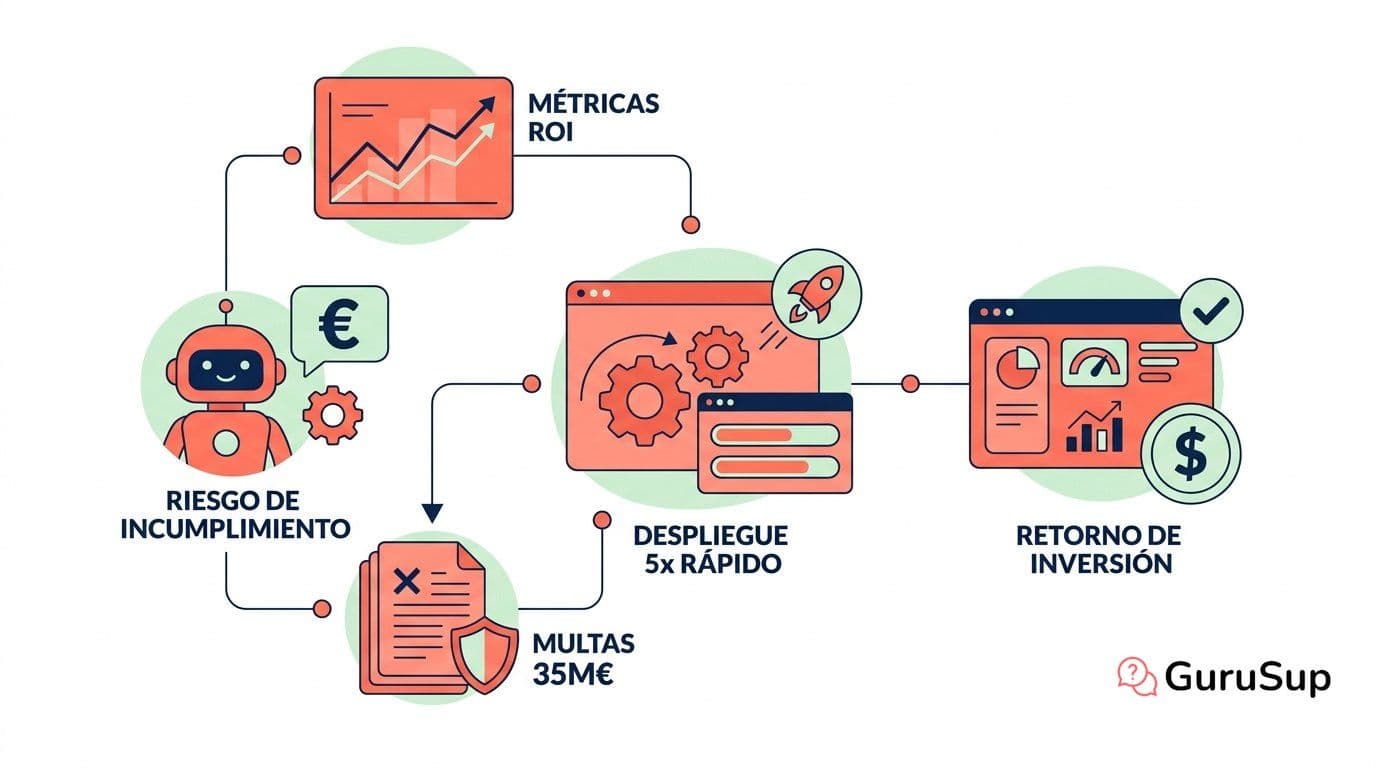
AI governance costs money. Policies, tools, training, audits, dedicated staff. The question every executive asks: is it worth it?
The answer is not philosophical. It is financial. Organizations with mature AI governance deploy AI systems faster, face fewer incidents, and avoid the regulatory penalties that can reach €35 million under the EU AI Act. Here is how to build the business case.
The Cost of No Governance
Start with what happens when governance is absent or weak:
- Regulatory fines — the EU AI Act imposes fines up to €35 million or 7% of global annual turnover for prohibited practices. High-risk system violations carry fines up to €15 million or 3% of turnover. These are not theoretical — enforcement begins in August 2025 for prohibited practices.
- Litigation costs — AI discrimination lawsuits are rising. In the US, EEOC has pursued cases against companies using biased AI in hiring. Settlement costs range from hundreds of thousands to tens of millions.
- Reputational damage — AI failures make headlines. A biased algorithm, a data breach through an AI system, or a chatbot going off-script generates coverage that marketing budgets cannot fix.
- Project failures — ungoverned AI projects have higher failure rates. Without clear standards, teams waste cycles on models that never pass legal review or fail in production due to untested edge cases.
- Talent loss — engineers and data scientists increasingly care about responsible AI. Organizations without governance frameworks lose talent to companies that take it seriously.
Measurable ROI of AI Governance
Faster deployment
This is the most counterintuitive benefit. Organizations expect governance to slow them down. The opposite happens. When teams have clear policies, risk classification frameworks, and pre-approved deployment checklists, they do not spend weeks in ad-hoc legal and compliance reviews.
Companies with established AI governance frameworks report up to 5x faster time-to-production for new AI systems. The governance framework answers questions before they become blockers: what data can we use? What testing is required? Who approves deployment?
Reduced incident costs
AI incidents in production are expensive. Each one involves investigation time, remediation, customer communication, and sometimes legal review. Governance controls — bias testing, monitoring, escalation rules — catch issues before they reach customers.
Track these metrics:
- Number of AI-related incidents per quarter
- Mean time to detect AI performance degradation
- Cost per incident (staff time + customer impact + remediation)
- Percentage of incidents caught by automated monitoring vs customer complaints
Competitive advantage
Enterprise buyers are asking vendors about AI governance. RFPs now include questions about bias testing, data handling, and compliance certifications. Companies with ISO 42001 certification or documented governance frameworks win deals their ungoverned competitors lose.
Insurance and liability
AI-related liability insurance is an emerging market. Insurers offer better rates to organizations with documented governance practices, just as cybersecurity insurance premiums are lower for companies with ISO 27001.
Building the Business Case
Frame governance investment in terms executives understand:
- Quantify your risk exposure — calculate potential fines based on your revenue and the AI systems you operate. Map each system to EU AI Act risk categories.
- Estimate incident costs — review past AI-related issues. What did they cost in staff time, customer impact, and remediation? Project those costs forward as AI usage scales.
- Benchmark deployment speed — measure how long it takes to get an AI system from prototype to production today. Compare with industry benchmarks for governed organizations.
- Calculate governance investment — tools, staff, training, and audit costs. This is typically 5-15% of total AI spend.
- Show the ratio — governance investment vs risk exposure. For most organizations, governance costs are a fraction of a single regulatory fine.
What Good Governance Costs
A realistic governance program for a mid-market company:
- Governance lead (or fractional role): €80-120K/year
- Governance tooling and monitoring: €30-60K/year
- Training and awareness: €10-20K/year
- External audits: €15-30K/year
- Total: €135-230K/year
Compare that to a single EU AI Act fine floor of €7.5 million for providing incorrect information to regulators. The math is not close.
Start building your governance capability now. Our AI governance tools guide covers the platforms that make governance operational, and our AI governance signal tracks regulatory developments that affect your risk exposure.