






AI Governance for Customer Support
Framework de gobernanza IA para soporte al cliente: monitorización de respuestas, manejo de datos personales.
 Víctor Mollá4 min read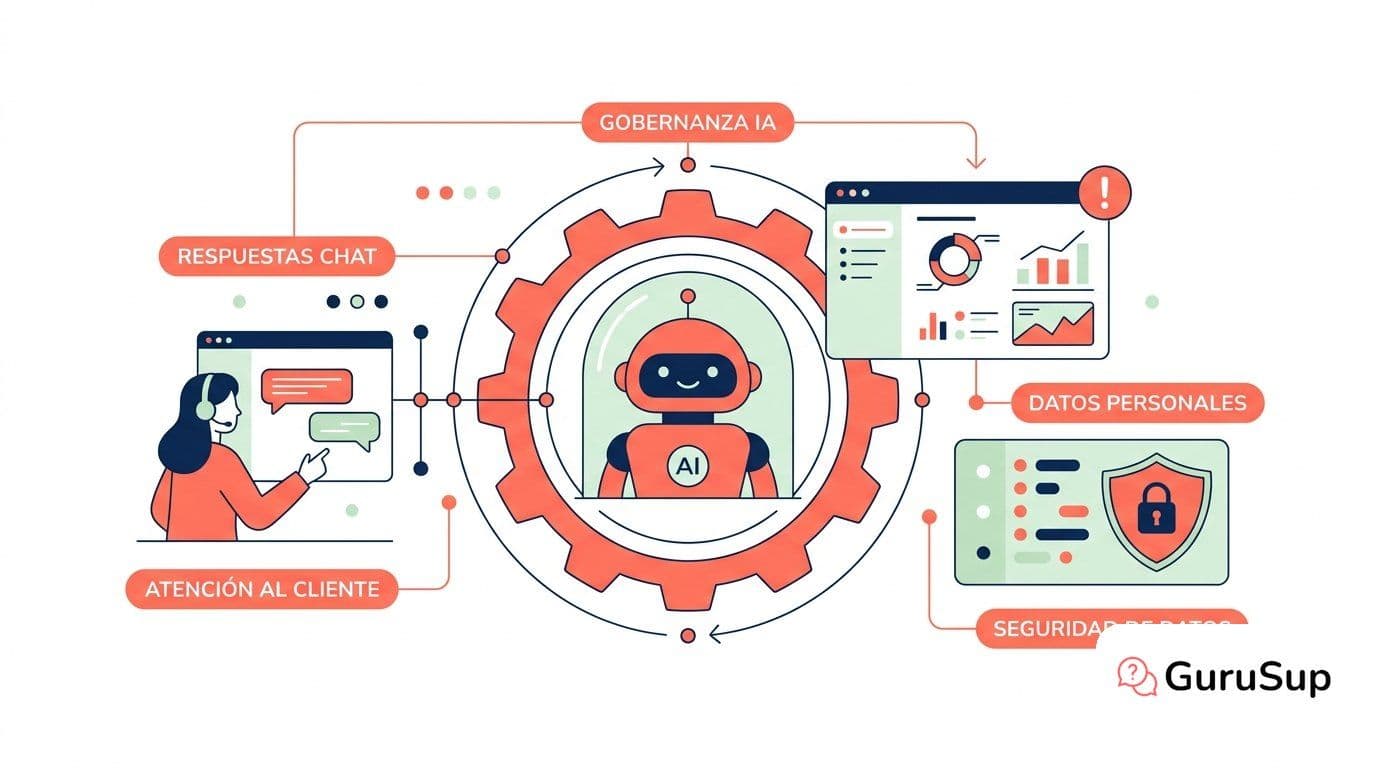
Customer support is where AI governance gets real. Every AI response touches a real person with a real problem. A hallucinated return policy, a leaked email address, or a tone-deaf reply to a frustrated customer does not stay in a test environment. It hits production. It hits your brand.
This guide covers the governance controls that support teams need when deploying AI agents, chatbots, or copilot tools. If you are building your broader AI governance framework, treat customer support as your first — and most visible — implementation.
Response Quality Monitoring
AI responses in support need continuous quality measurement, not just at launch but every day the system runs.
Set up three layers of monitoring:
- Automated quality scoring — use a second LLM or rule-based system to evaluate every AI response against accuracy, tone, and completeness criteria. Flag responses that score below your threshold for human review.
- Statistical sampling — human reviewers check a random sample of AI responses daily. Track accuracy rates, hallucination frequency, and tone consistency over time.
- Customer feedback loops — post-interaction surveys and thumbs up/down ratings tied to specific AI responses, not just the overall experience.
The goal is catching drift before customers do. AI response quality degrades over time as products change, policies update, and edge cases accumulate. Without monitoring, you will not know until complaint volume spikes.
PII Handling and Data Protection
Support conversations are full of personal data: names, emails, order numbers, payment details, sometimes health information or government IDs. Your AI system needs strict guardrails.
- Input filtering — detect and redact PII from prompts sent to AI models, especially if using external APIs. Never send raw customer data to a third-party model without sanitization.
- Output filtering — prevent AI from surfacing PII from other customers in responses. This is a common failure when retrieval-augmented generation pulls from shared knowledge bases.
- Retention limits — define how long AI conversation logs are stored. Align with GDPR (right to erasure), CCPA, and your privacy policy.
- Access controls — restrict who can access AI conversation logs. Support agents see their assigned tickets. Analysts see anonymized aggregates. Full logs require manager approval.
Escalation Rules
Not every customer interaction should be handled by AI. Define clear escalation triggers:
- Confidence threshold — if the AI's confidence score drops below a defined level, route to a human agent.
- Topic restrictions — legal threats, billing disputes above a threshold, safety issues, and complaints involving discrimination should always go to humans.
- Emotional detection — when sentiment analysis detects high frustration or distress, escalate. AI handling angry customers often makes things worse.
- Loop detection — if the AI gives the same response twice or the conversation exceeds a turn limit without resolution, hand off.
- Customer request — any customer who asks to speak with a human gets a human. This is non-negotiable.
Document these rules in a decision matrix that agents and AI systems both reference. Review the matrix quarterly based on escalation data.
Compliance Checklist
Use this checklist for any AI deployment in customer support:
- Disclosure — customers know they are interacting with AI, not a human. Required under the EU AI Act for all chatbots.
- Data processing agreement — signed DPA with your AI provider covering data handling, subprocessors, and breach notification.
- Bias testing — tested AI responses across customer demographics, languages, and accent types. See our AI bias detection guide.
- Fallback mechanism — human agents are available during all hours the AI operates. Maximum wait time for escalation is defined and monitored.
- Logging and audit trail — every AI decision is logged with inputs, outputs, confidence scores, and the model version used.
- Incident response plan — documented procedure for AI failures: who gets notified, how fast, and what the rollback process looks like.
- Regular review cycle — governance controls are reviewed at minimum quarterly. Responsible person is named, not a committee.
Making Governance Operational
Governance documents that sit in a shared drive do nothing. Embed governance into your support operations:
- Build quality gates into your AI deployment pipeline — no model goes live without passing bias tests and quality benchmarks.
- Add governance metrics to your support dashboard alongside resolution time and CSAT.
- Train support agents on AI oversight, not just AI usage. They need to know when to override and how to report issues.
Explore our AI governance tools guide for platforms that automate monitoring and compliance tracking. For the strategic view on where governance is heading, see our AI governance signal.