






EU AI Act Compliance Checklist
Step-by-step compliance checklist for the EU AI Act: documentation, risk management, conformity assessment, and practical steps for each risk tier.
 Víctor Mollá5 min read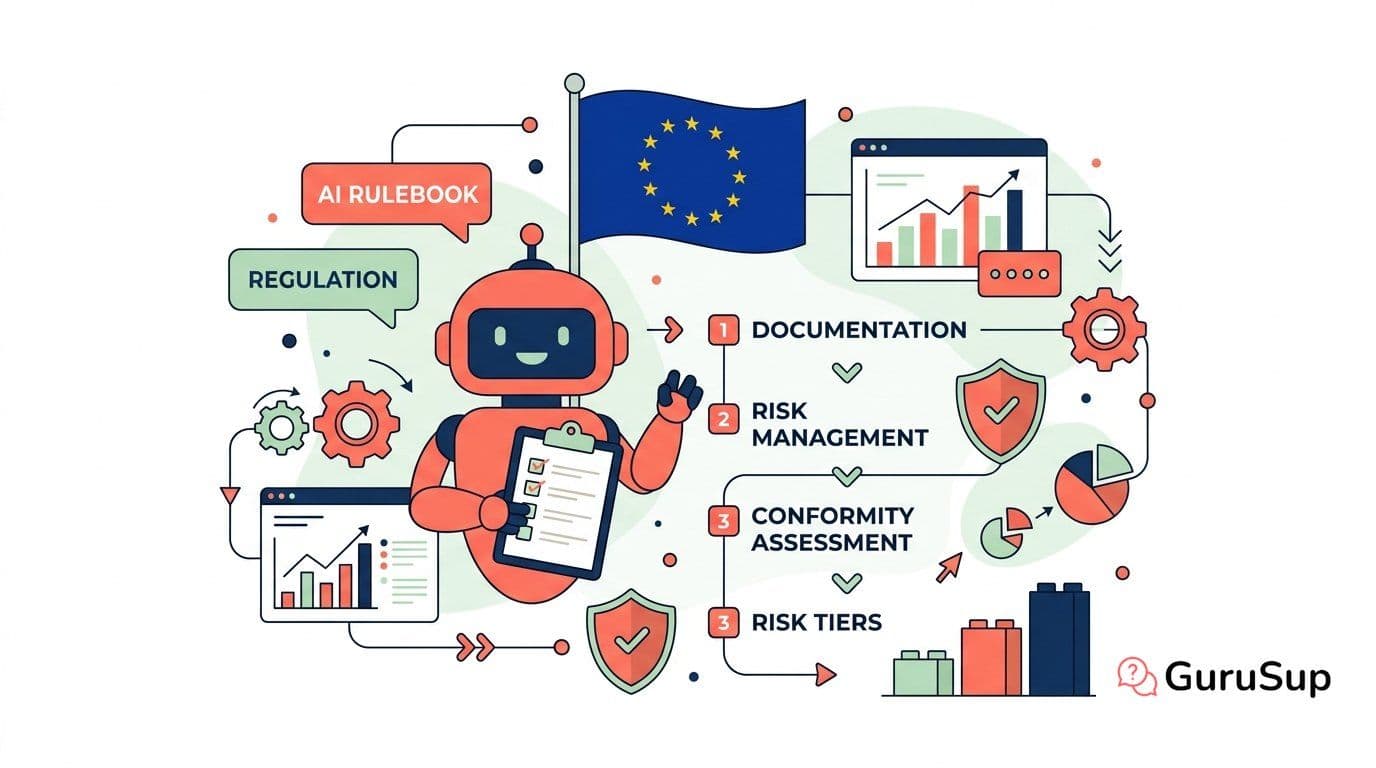
Compliance with the EU AI Act is not a single action. It is a sequence of steps that vary based on your AI system's risk classification. This checklist gives you a concrete path from assessment to conformity, organized by what you need to do and when.
If you have not yet classified your systems, start with our risk classification guide.
Step 1: AI System Inventory
Before you can comply, you need to know what you have.
- List every AI system your organization develops, deploys, or procures.
- Document the purpose, input data types, output decisions, and affected user groups for each.
- Identify whether you act as provider, deployer, importer, or distributor for each system.
- Map each system to a risk tier (unacceptable, high, limited, minimal).
This inventory becomes your compliance backbone. Update it every time you add, modify, or retire an AI system.
Step 2: Eliminate Prohibited Systems
The ban on unacceptable-risk AI took effect February 2, 2025. If your inventory includes any prohibited system, decommission it immediately.
Check for: social scoring mechanisms, untargeted biometric scraping, subliminal manipulation techniques, emotion recognition in workplaces (unless safety-critical), and real-time remote biometric identification in public spaces (unless under the narrow law-enforcement exceptions). See the full EU AI Act summary for the complete prohibited list.
Step 3: High-Risk System Requirements
This is the bulk of compliance work. Each requirement below maps to a specific article in the regulation.
3.1 Risk Management System (Article 9)
- Establish a risk management process that runs throughout the AI system's lifecycle.
- Identify and analyze known and foreseeable risks.
- Implement mitigation measures and test their effectiveness.
- Document residual risks and communicate them to deployers.
- Review and update the risk assessment when the system or its context changes.
3.2 Data Governance (Article 10)
- Define criteria for training, validation, and testing datasets.
- Ensure datasets are relevant, representative, and as free of errors as reasonably achievable.
- Address potential biases, especially when processing special categories of personal data.
- Document data provenance, collection methods, and preprocessing steps.
- If personal data is involved, ensure GDPR compliance runs in parallel. See our AI Act vs GDPR comparison.
3.3 Technical Documentation (Article 11)
- Prepare documentation before the system enters the market.
- Include: general system description, design specifications, development process, risk management measures, data governance practices, performance metrics, and known limitations.
- Keep documentation updated for the system's entire commercial lifetime plus 10 years.
3.4 Record-Keeping and Logging (Article 12)
- Implement automatic logging of system events.
- Logs must enable tracing of operations back to specific inputs and decisions.
- Retain logs for a period appropriate to the system's purpose, minimum as defined by applicable sectoral law.
3.5 Transparency and Information (Article 13)
- Provide deployers with clear instructions for use.
- Document the system's intended purpose, level of accuracy, and known limitations.
- Specify the human oversight measures needed for safe operation.
- Include information about expected input data characteristics.
3.6 Human Oversight (Article 14)
- Design systems so humans can effectively oversee their operation.
- Enable the human overseer to understand the system's capabilities and limitations.
- Provide tools to interpret system output and override or reverse decisions.
- Include a stop function or the ability to intervene in real time where appropriate.
3.7 Accuracy, Robustness, Cybersecurity (Article 15)
- Declare accuracy levels and metrics in technical documentation.
- Test resilience against errors, faults, and adversarial attacks.
- Implement cybersecurity measures proportionate to the risk.
- Address potential vulnerabilities from data poisoning, model manipulation, and input exploitation.
Step 4: Conformity Assessment
Before placing a high-risk system on the market, you must complete a conformity assessment.
- For most Annex III systems: self-assessment following Annex VI procedures.
- For biometric identification systems: assessment by a notified body (third party).
- For Annex I systems: follow the existing sectoral conformity assessment, updated for AI requirements.
- Result: a declaration of conformity and CE marking.
Step 5: Limited-Risk Transparency Obligations
If your system is limited risk, compliance is lighter but still mandatory:
- Chatbots and conversational AI: disclose AI nature to users before or at the start of interaction. Details in our chatbot requirements guide.
- AI-generated content (text, audio, images, video): label it as artificially generated.
- Emotion recognition: inform subjects that the system is operating.
- For customer support teams, this typically means a disclosure banner or message at conversation start.
Step 6: Registration and Monitoring
- Register high-risk AI systems in the EU database before market placement.
- Implement post-market monitoring proportionate to the system's risk.
- Report serious incidents to national authorities within 15 days of becoming aware.
- Cooperate with market surveillance authorities upon request.
Step 7: Ongoing Compliance
- Schedule periodic reviews of risk assessments and technical documentation.
- Monitor system performance against declared accuracy levels.
- Update the system's conformity assessment after substantial modifications.
- Track regulatory updates from the European AI Office and national authorities.
- Train staff involved in AI system operation and oversight.
The enforcement timeline governs when each requirement becomes enforceable. The penalty structure shows the cost of non-compliance.